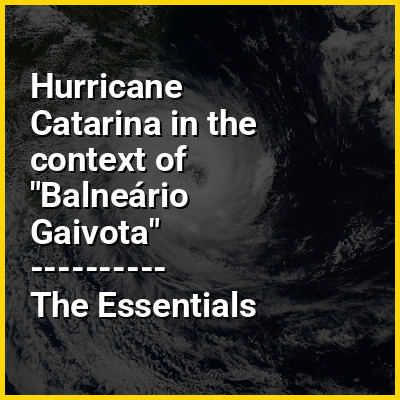
Hurricane Catarina, or Cyclone Catarina (Portuguese pronunciation: [kataˈɾinɐ]) was an extraordinarily rare South Atlantic tropical cyclone that became the only recorded hurricane-strength cyclone in the South Atlantic Ocean. Catarina made landfall in the South Region of Brazil at peak intensity, with the equivalent of Category 2 hurricane-force sustained winds, on 28 March 2004.
The storm developed out of a stationary cold-core upper-level trough on 12 March. Almost a week later, on 19 March, a disturbance developed along the trough and traveled towards the west-southwest until 22 March when a ridge stopped the forward motion of the disturbance. The disturbance was in an unusually favorable environment with a slightly below-average wind shear and above-average sea surface temperatures. The combination of the two led to a slow transition from an extratropical cyclone to a subtropical cyclone by 24 March. The storm continued to obtain tropical characteristics and became a tropical storm the next day while the winds steadily increased. The storm attained wind speeds of 121 km/h (75 mph)—equivalent to a low-end Category 1 hurricane on the Saffir–Simpson scale—on 26 March. At that time, it was unofficially named Catarina and was also the first hurricane-strength tropical cyclone ever recorded in the Southern Atlantic Ocean. Abnormally favorable conditions persisted, resulting in Catarina intensifying further, and it would peak with 1-minute sustained winds of 160 km/h (100 mph) on 28 March. The center of the storm made landfall between the cities of Passo de Torres and Balneário Gaivota, Santa Catarina soon after. Catarina rapidly weakened upon landfall and dissipated later that day.