Hunnestad Monument in the context of "Jötunn"

Play Trivia Questions online!

or

Skip to study material about Hunnestad Monument in the context of "Jötunn"

Ad spacer

⭐ Core Definition: Hunnestad Monument

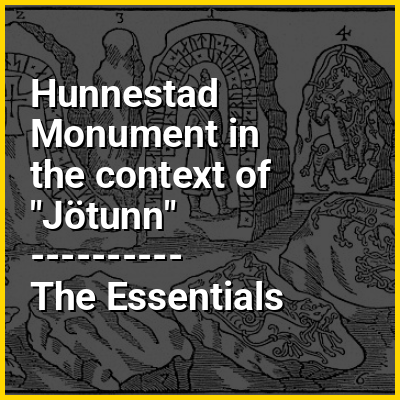
The Hunnestad Monument (Swedish: Hunnestadsmonumentet), listed as DR 282 through 286 in the Rundata catalog, was once located at Hunnestad at Marsvinsholm north-west of Ystad, Sweden. It was the largest and most famous of the Viking Age monuments in Scania, and in Denmark, only comparable to the Jelling stones. The monument was destroyed during the end of the 18th century by Eric Ruuth of Marsvinsholm, probably between 1782 and 1786 when the estate was undergoing sweeping modernization, though the monument survived long enough to be documented and depicted.

When the antiquary Ole Worm (1588–1654) explored the monument, it consisted of eight stones. Five of them were image stones, and two of those image stones also had runic inscriptions. In the eighteenth century, all the stones were relocated or destroyed. Only three of the stones of the monument were recovered during the 19th century, and are today on display at the Kulturen museum in Lund. For a long time they were considered the only stones remaining, but on December 16, 2020 a fourth stone, DR 285 (number 6, in the picture), was discovered during excavations for a sewage line in Ystad municipality. Lying with its image facing up, it had been used in a bridge construction over the Hunnestad stream.
↓ Menu

>>>PUT SHARE BUTTONS HERE<<<
In this Dossier

Hunnestad Monument in the context of Jötnar

A jötunn (also jotun; plural jötnar; in the normalised scholarly spelling of Old Norse, jǫtunn /ˈjɔːtʊn/; or, in Old English, eoten, plural eotenas) is a type of being in Germanic mythology. In Norse mythology, jötnar are often contrasted with gods (the Æsir and Vanir) and with other non-human figures, such as dwarfs and elves, although the groupings are not always mutually exclusive. The entities included in the jötunn category are referred to by several other terms, including risi, þurs (or thurs) and troll if male and gýgr or tröllkona if female. The jötnar typically dwell across boundaries from the gods and humans in lands such as Jötunheimr.

The jötnar are frequently attested throughout the Old Norse records, with eotenas also featuring in the Old English epic poem Beowulf. The usage of the terms is dynamic, with an overall trend that the beings become portrayed as less impressive and more negative as Christianity becomes more influential over time. Although the term "giant" is sometimes used to gloss the word "jötunn" and its apparent synonyms in some translations and academic texts, this is seen as problematic by some scholars as jötnar are not necessarily notably large.

↑ Return to Menu

Hunnestad Monument in the context of Hyrrokkin

Hyrrokkin (Old Norse: [ˈhyrˌrokːenː]) is a female jötunn in Norse mythology. According to 13th-century poet Snorri Sturluson, she launched the largest of all ships at Baldr's funeral after the Æsir gods were unable to budge the vessel.

Hyrrokkin was a relatively important figure in the last decades of paganism in Iceland. She appears to be depicted on one of the DR 284 stones from the Hunnestad Monument near Marsvinsholm, Sweden.

↑ Return to Menu

Hunnestad Monument in the context of Jötunheimr

The terms Jötunheimr (in Old Norse orthography: Jǫtunheimr [ˈjɔtonˌhɛimz̠]; often anglicised as Jotunheim) or Jötunheimar refer to either a land or multiple lands respectively in Nordic mythology inhabited by the jötnar (relatives of the gods, in English sometimes inaccurately called "giants").

Jötunheimar are typically, but not exclusively, presented in Eddic sources as prosperous lands located to the north and are commonly separated from the lands inhabited by gods and humans by barriers that cannot be traversed by usual means.

↑ Return to Menu