Human rib cage in the context of "Costal cartilage"

Play Trivia Questions online!

or

Skip to study material about Human rib cage in the context of "Costal cartilage"

Ad spacer

⭐ Core Definition: Human rib cage

The rib cage or thoracic cage is an endoskeletal enclosure in the thorax of most vertebrates that comprises the ribs, vertebral column and sternum, which protect the vital organs of the thoracic cavity, such as the heart, lungs and great vessels and support the shoulder girdle to form the core part of the axial skeleton.

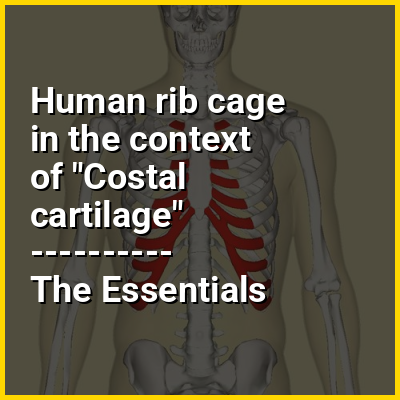
A typical human thoracic cage consists of 12 pairs of ribs and the adjoining costal cartilages, the sternum (along with the manubrium and xiphoid process), and the 12 thoracic vertebrae articulating with the ribs. The thoracic cage also provides attachments for extrinsic skeletal muscles of the neck, upper limbs, upper abdomen and back, and together with the overlying skin and associated fascia and muscles, makes up the thoracic wall.
↓ Menu

>>>PUT SHARE BUTTONS HERE<<<
In this Dossier

Human rib cage in the context of Human skeleton

The human skeleton is the internal framework of the human body. It is composed of around 270 bones at birth – this total decreases to around 206 bones by adulthood after some bones get fused together. The bone mass in the skeleton makes up about 14% of the total body weight (ca. 10–11 kg for an average person) and reaches maximum mass between the ages of 25 and 30. The human skeleton can be divided into the axial skeleton and the appendicular skeleton. The axial skeleton is formed by the vertebral column, the rib cage, the skull and other associated bones. The appendicular skeleton, which is attached to the axial skeleton, is formed by the shoulder girdle, the pelvic girdle and the bones of the upper and lower limbs.

The human skeleton performs six major functions: support, movement, protection, production of blood cells, storage of minerals, and endocrine regulation.

↑ Return to Menu

Human rib cage in the context of Wasp waist

Wasp waist is a women's fashion silhouette, produced by a style of corset and girdle, that has experienced various periods of popularity in the 19th and 20th centuries. Its primary feature is the abrupt transition from a natural-width rib cage to an exceedingly small waist, with the hips curving out below. It takes its name from its similarity to a wasp's segmented body. The sharply cinched waistline also exaggerates the hips and bust.

↑ Return to Menu