Huascarán National Park in the context of Cordillera Blanca


Huascarán National Park in the context of Cordillera Blanca

⭐ Core Definition: Huascarán National Park

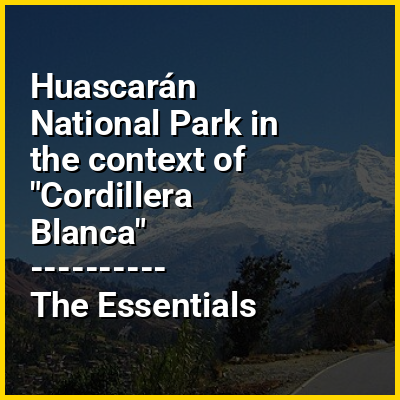
Huascarán National Park (Spanish: Parque Nacional Huascarán) is a Peruvian national park that protects most of the mountain range known as Cordillera Blanca (the world's highest tropical mountain range) which is part of the central Andes, in the region of Ancash. The park covers an area of 340,000 hectares (840,000 acres) and is managed by the Peruvian Network of Protected Natural Areas, or SERNANP (Servicio Nacional de Áreas Naturales Protegidas). Designated as a World Heritage Site in 1985 by UNESCO, Huascaráan is also a well-known mountaineering spot, and harbors a unique biodiversity with plant species such as the Queen of the Andes, trees of the genera Polylepis and Buddleja, and animals such as spectacled bears, condors, vicunas, and tarucas.

The park is approximately 150 kilometers (93 mi) long from north to south and averages about 25 kilometers (16 mi) in width. The western slope of the Cordillera Blanca drains to the Pacific Ocean via the Santa River and the eastern slopes drain to the Marañón River and ultimately to the Amazon River and the Atlantic Ocean.
↓ Menu
HINT:

👉 Huascarán National Park in the context of Cordillera Blanca

The Cordillera Blanca (Spanish for "white range") is a mountain range in Peru that is part of the larger Andes range and extends for 200 kilometres (124 mi) between 8°08' and 9°58'S and 77°00' and 77°52'W, in a northwesterly direction. It includes several peaks over 6,000 metres (19,690 ft) high and 722 individual glaciers. The highest mountain in Peru, Huascarán, at 6,768 metres (22,205 ft) high, is located there.

The Cordillera Blanca lies in the Ancash region and runs parallel to the Santa River valley (also called Callejón de Huaylas in its upper and midsections) on the west. Huascarán National Park, established in 1975, encompasses almost the entire range of the Cordillera Blanca.

↓ Explore More Topics
In this Dossier

Huascarán National Park in the context of Huaraz

Huaraz ([waˈɾas]) (from Quechua: Waraq or Warash, "dawn"), formerly designated as San Sebastián de Huaraz, is a city in Peru. It is the capital of the Ancash Region (State of Ancash) and the seat of government of Huaraz Province. The urban area's population is distributed over the districts of Huaraz and Independencia. The city is located in the middle of the Callejon de Huaylas valley and on the right side of the Santa river. The city has an elevation of approximately 3050 meters above sea level. The built-up area covers 8 square kilometers and has a population of 120,000 inhabitants, making it the second largest city in the central Peruvian Andes after the city of Huancayo. It is the 22nd largest city in Peru. Huaraz is the seat of the province's Roman Catholic Bishop and the site of the cathedral.

Huaraz is the main financial and trade center of the Callejón de Huaylas and the main tourist destination of Ancash region. Moreover, it is one of the biggest towns in the Peruvian Andes. Huaraz is the main destinations for winter sports and adventure. Many visitors from around the world come to the city for practicing sports as climbing, hiking, mountain biking and snowboarding, and also to visit the glaciers and mountains of the Cordillera Blanca, mainly Mount Huascarán, which is considered the tallest mountain in the tropics, all of them located in Huascarán National Park which UNESCO declared a nature world heritage site in 1985.

View the full Wikipedia page for Huaraz
↑ Return to Menu