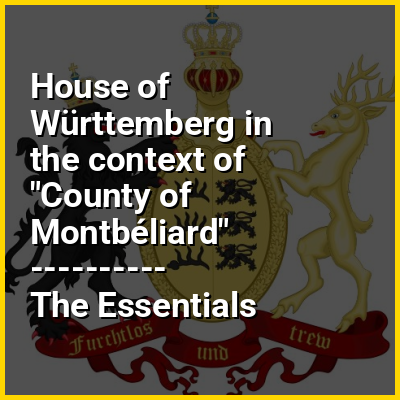
The House of Württemberg is an ancient German dynasty and former royal family of the Kingdom of Württemberg.
HINT:
👉 House of Württemberg in the context of County of Montbéliard
The Princely County of Montbéliard (French: Comté princier de Montbéliard; German: Grafschaft Mömpelgard), was a princely county of the Holy Roman Empire seated in the city of Montbéliard in the present-day Franche-Comté region of France. From 1444 onwards it was held by the House of Württemberg. It had full voting rights in the Reichstag.
In this Dossier
- ⭐ Core Definition: House of Württemberg
- 👉 House of Württemberg in the context of County of Montbéliard
- House of Württemberg in the context of Sophie Dorothea of Württemberg
- House of Württemberg in the context of County of Württemberg
- House of Württemberg in the context of Wirtemberg Castle
House of Württemberg in the context of Sophie Dorothea of Württemberg
Maria Feodorovna (Russian: Мария Фёдоровна; Sophie Marie Dorothea Auguste Luise; 25 October 1759 – 5 November 1828 [OS 24 October]) became Empress of Russia as the second wife of Emperor Paul I. She founded the Office of the Institutions of Empress Maria.
Daughter of Duke Frederick Eugene of Württemberg and Princess Friederike of Brandenburg-Schwedt, Sophie Dorothea belonged to a junior branch of the House of Württemberg and grew up in Montbéliard, receiving an excellent education for her time. After Grand Duke Paul (the future Paul I of Russia) became a widower in 1776, King Frederick II of Prussia (Sophie Dorothea's maternal great-uncle) and Empress Catherine II of Russia chose Sophie Dorothea as the ideal candidate to become Paul's second wife. In spite of her fiancé's difficult character, she developed a long, peaceful relationship with Paul and converted to the Russian Orthodox Church in 1776, adopting the name Maria Feodorovna. During the long reign (1762–1796) of her mother-in-law, she sided with her husband and lost the initial affection the reigning Empress had for her. The couple were completely excluded from any political influence, as mother and son mistrusted each other. They were forced to live in isolation at Gatchina Palace, where they had many children together.
View the full Wikipedia page for Sophie Dorothea of WürttembergHouse of Württemberg in the context of County of Württemberg
The County of Württemberg was a historical territory with origins in the realm of the House of Württemberg, the heart of the old Duchy of Swabia. Its capital was Stuttgart. From the 12th century until 1495, it was a county within the Holy Roman Empire. It later became a duchy and, after the breakup of the Holy Roman Empire, a kingdom.
View the full Wikipedia page for County of WürttembergHouse of Württemberg in the context of Wirtemberg Castle
Wirtemberg Castle, a ruined hilltop castle, is the second family seat of the House of Württemberg, whose ancestors had abandoned Beutelsbach Castle (also known as "Kappelberg Castle"). Built on the eponymous Württemberg mountain in a spur of the Schurwald around 411 m (1,348 ft) above sea level, it is located in the current municipality of Rotenberg in Stuttgart, between Bad Cannstatt and Esslingen am Neckar. Between 1080 and 1819, three castles with this name existed in the area.
View the full Wikipedia page for Wirtemberg Castle