Hostal dos Reis Católicos in the context of Santiago de Compostela


Hostal dos Reis Católicos in the context of Santiago de Compostela

⭐ Core Definition: Hostal dos Reis Católicos

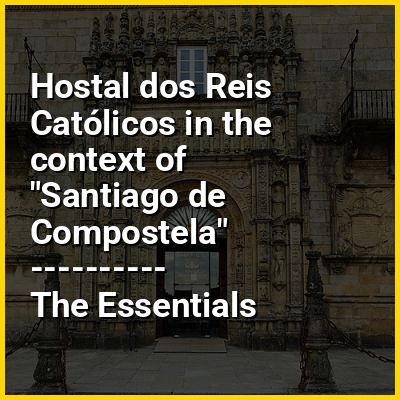
The Hostal dos Reis Católicos (in Galician), also called the Hostal de Los Reyes Católicos (in Spanish) or Parador de Santiago de Compostela, is a five-star Parador hotel, located in the Praza do Obradoiro of Santiago de Compostela, Spain. It is widely considered one of the oldest continuously operating hotels in the world, and has also been called the "most beautiful hotel in Europe".

In 1486, after a pilgrimage to Santiago de Compostela, Queen Isabella I of Castile and King Ferdinand II of Aragon, the Catholic Monarchs of Spain, decided to build a hostelry and hospital for pilgrims at the very end of the Way of St James. They provided the necessary funds in 1499, construction began in 1501 and it took over ten years. It continued with this function for four centuries. In 1953, the hospital was moved to a new location nearby, and in 1954 it opened as a hotel after undergoing a renovation. In 1986, it was incorporated to the Paradores network. Nowadays, with its 137 rooms it is the finest and largest by capacity parador of the network, and continuing its hospitable tradition, it provides free services to a limited number of pilgrims every day.
↓ Menu
HINT:

In this Dossier

Hostal dos Reis Católicos in the context of Plateresque

Plateresque, meaning "in the manner of a silversmith" (plata being silver in Spanish), was an artistic movement, especially architectural, developed in Spain and its territories, which appeared between the late Gothic and early Renaissance in the late 15th century and spread over the next two centuries. It is a modification of Gothic spatial concepts and an eclectic blend of Mudéjar, Flamboyant, Gothic, and Lombard decorative components, as well as Renaissance elements of Tuscan origin.

Examples of this syncretism are the inclusion of shields and pinnacles on façades, columns built in the Renaissance neoclassical manner, and façades divided into three parts (in Renaissance architecture they are divided into two). It reached its peak during the reign of Charles V, Holy Roman Emperor, especially in Salamanca, but also flourished in other such cities of the Iberian Peninsula as León, Burgos, Santiago de Compostela, also in the territory of New Spain, which is now Mexico, and in Bogotá.

View the full Wikipedia page for Plateresque
↑ Return to Menu