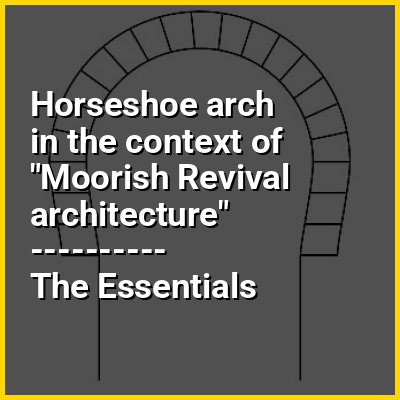
The horseshoe arch (Arabic: قوس حدوة الحصان; Spanish: arco de herradura), also called the Moorish arch and the keyhole arch, is a type of arch in which the circular curve is continued below the horizontal line of its diameter, so that the opening at the bottom of the arch is narrower than the arch's full span. Evidence for the earliest uses of this form are found in Late Antique and Sasanian architecture, and it was then used in Spain by the Visigoths. But in the 19th century, perhaps when these earlier uses had not been realized, it became emblematic of Islamic architecture, especially Moorish architecture and Mozarabic art in Iberia. It also made later appearances in Moorish Revival and Art Nouveau styles. Horseshoe arches can take rounded, pointed or lobed form.
- ⭐ Core Definition: Horseshoe arch
- Horseshoe arch in the context of Mosque of Uqba
- Horseshoe arch in the context of Moroccan architecture
- Horseshoe arch in the context of Neo-Mudéjar
- Horseshoe arch in the context of Sueca, Valencia
Horseshoe arch in the context of Mosque of Uqba
The Great Mosque of Kairouan (Arabic: جامع القيروان الأكبر), also known as the Mosque of Uqba (جامع عقبة بن نافع), is a mosque situated in the UNESCO World Heritage town of Kairouan, Tunisia and is one of the largest Islamic monuments in North Africa.
Established by the Arab general Uqba ibn Nafi in 50 AH (670/671 CE) at the founding of the city of Kairouan, the mosque occupies an area of over 9,000 square metres (97,000 sq ft). It is one of the oldest places of worship in the Islamic world, and is a model for all later mosques in the Maghreb. Its perimeter, of about 405 metres (1,329 ft), contains a hypostyle prayer hall, a marble-paved courtyard and a square minaret. In addition to its spiritual prestige, the Mosque of Uqba is one of the masterpieces of Islamic architecture, notable among other things for the first Islamic use of the horseshoe arch.
View the full Wikipedia page for Mosque of UqbaHorseshoe arch in the context of Moroccan architecture
Moroccan architecture reflects Morocco's diverse geography and long history, marked by successive waves of settlers through both migration and military conquest. This architectural heritage includes ancient Roman sites, historic Islamic architecture, local vernacular architecture, 20th-century French colonial architecture, and modern architecture.
Much of Morocco's traditional architecture is marked by the style that developed during the Islamic period, from the 7th century onward. This architecture was part of a wider tradition of "Moorish" or western Islamic architecture, which characterized both the Maghreb (Morocco, Algeria, and Tunisia) and al-Andalus (Muslim Spain and Portugal). It blended influences from Amazigh (Berber) culture in North Africa, pre-Islamic Spain (Roman, Byzantine, and Visigothic), and contemporary artistic currents in the Islamic Middle East to elaborate a unique style over centuries with recognizable features such as the horseshoe arch, riad gardens, and elaborate geometric and arabesque motifs in wood, carved stucco, and zellij tilework.
View the full Wikipedia page for Moroccan architectureHorseshoe arch in the context of Neo-Mudéjar
Neo-Mudéjar is a type of Moorish Revival architecture practised in the Iberian Peninsula and to a far lesser extent in Ibero-America. This architectural movement emerged as a revival of Mudéjar style. It was an architectural trend of the late 19th and early 20th centuries that began in Madrid and Barcelona and quickly spread to other regions in Spain and Portugal. It used Mudéjar style elements such as the horseshoe arch, arabesque tiling, and abstract shaped brick ornamentations for the façades of modern buildings.
View the full Wikipedia page for Neo-MudéjarHorseshoe arch in the context of Sueca, Valencia
Sueca (Valencian: [suˈɛka], also [suˈɛkɛ]; Spanish: [ˈsweka] ) is a city in eastern Spain in the Valencian Community. It is situated on the left bank of the river Xúquer. The town of Sueca is separated from the Mediterranean Sea 11 kilometres (7 miles) to the east by the Serra de Cullera, though the municipality possesses 7 km (4 mi) of Mediterranean coastline. Some of the architecture shows Moorish roots—the flat roofs, view-turrets (miradors), and horseshoe arches—and the area has an irrigation system dating from Moorish times. Rice processing is the principal industry, though oranges are also exported.
View the full Wikipedia page for Sueca, Valencia