Hohenzollern Castle in the context of Hohenzollerns


Hohenzollern Castle in the context of Hohenzollerns

⭐ Core Definition: Hohenzollern Castle

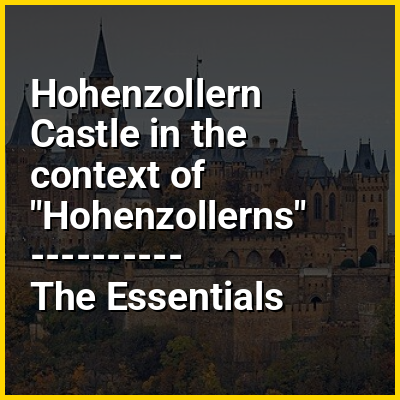
Hohenzollern Castle (German: Burg Hohenzollern [bʊʁk hoːənˈtsɔlɐn] ) is the ancestral seat of the imperial House of Hohenzollern. The third of three hilltop castles built on the site, it is located atop Mount Hohenzollern, above and south of Hechingen, on the edge of the Swabian Jura of central Baden-Württemberg, Germany. The name derives from Söller (terrace) from Latin solarium.

The first castle on the mountain was constructed in the early 11th century. Over the years the House of Hohenzollern split several times, but the castle remained in the Swabian branch, the dynastic seniors of the Franconian-Brandenburgian cadet branch that later acquired its own imperial throne. This castle was completely destroyed in 1423 after a ten-month siege by the free imperial cities of Swabia.
↓ Menu
HINT:

In this Dossier

Hohenzollern Castle in the context of House of Hohenzollern

The House of Hohenzollern (/ˌhənˈzɒlərn/, US also /-nˈzɔːl-, -ntˈsɔːl-/; German: Haus Hohenzollern, pronounced [ˌhaʊs hoːənˈtsɔlɐn] ; Romanian: Casa de Hohenzollern) is a formerly royal (and from 1871 to 1918, imperial) German dynasty whose members were variously princes, electors, kings and emperors of Hohenzollern, Brandenburg, Prussia, the German Empire, and Romania. The family came from the area around the town of Hechingen in Swabia during the late 11th century and took their name from Hohenzollern Castle. The first ancestors of the Hohenzollerns were mentioned in 1061.

The Hohenzollern family split into two branches, the Catholic Swabian branch and the Protestant Franconian branch, which ruled the Burgraviate of Nuremberg and later became the Brandenburg-Prussian branch. The Swabian branch ruled the principalities of Hohenzollern-Hechingen and Hohenzollern-Sigmaringen until 1849, and also ruled Romania from 1866 to 1947. Members of the Franconian branch became Margrave of Brandenburg in 1415 and Duke of Prussia in 1525.

View the full Wikipedia page for House of Hohenzollern
↑ Return to Menu

Hohenzollern Castle in the context of Burgraviate of Nuremberg

The Burgraviate of Nuremberg (German: Burggrafschaft Nürnberg) was a state of the Holy Roman Empire from the early 12th to the late 15th centuries. As a burgraviate, it was a county seated in the town of Nuremberg; almost two centuries passed before the burgraviate lost power over the city, which became independent from 1219. Eventually, the burgraviate was partitioned to form Brandenburg-Ansbach and Brandenburg-Bayreuth.

View the full Wikipedia page for Burgraviate of Nuremberg
↑ Return to Menu

Hohenzollern Castle in the context of Albtrauf

The term Albtrauf (Alp escarpment) refers to the northwest facing escarpment of the Swabian Alps, situated in Baden-Württemberg and Bavaria. It is the most distinctive stepped slope within the alpine region of the South German Scarplands, leading roughly from the southwest to the northeast.

The Albtrauf has its geological extension in the northeast, in the stepped slopes of the Franconian Jura and in the southwest and west among the Jurassic period stepped slopes of the Baaralb, Hegaualb, Randen, Klettgau, Aargau as well as the Table Jura stretches from the city of Basel to the Ajoie and the French Scarplands.

View the full Wikipedia page for Albtrauf
↑ Return to Menu

Hohenzollern Castle in the context of Hilltop castle

A hilltop castle is a type of hill castle that was built on the summit of a hill or mountain. In the latter case it may be termed a mountaintop castle. The term is derived from the German, Gipfelburg, which is one of a number of terms used in continental castellology to classify castles by topology.The chief advantage of such a strategically selected site was its inaccessibility. The steep flanks of the hill made assaults on the castle difficult or, depending on the terrain, even impossible. In addition, it often commanded excellent fields of view and fire over the surrounding countryside. The sheer height of the castle above the local area could also protect the occupants of the castle from bombardment. In addition, the prominent location of such a castle enhanced its status as a residence.

Nevertheless, hilltop castles presented their logistic difficulties. Without sufficiently strong pumps, water supply could be problematic if there was no well in the vicinity. The transport of food, working animals and other goods was also made more difficult by the location, and the adverse weather usually found on hilltops made living conditions in such a castle less comfortable.

View the full Wikipedia page for Hilltop castle
↑ Return to Menu