History of far-right movements in France in the context of Camelots du Roi


History of far-right movements in France in the context of Camelots du Roi

⭐ Core Definition: History of far-right movements in France

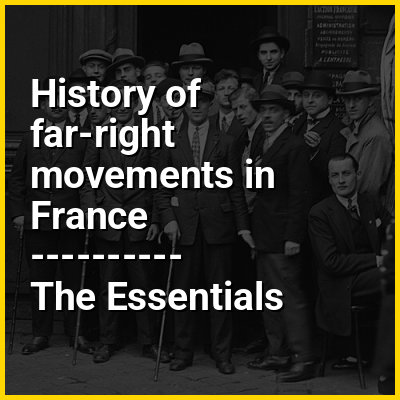
The far-right (French: Extrême droite) tradition in France finds its origins in the Third Republic with Boulangism and the Dreyfus affair. In the 1880s, General Georges Boulanger, called "General Revenge" (Général Revanche), championed demands for military revenge against Imperial Germany as retribution for the defeat and fall of the Second French Empire during the Franco-Prussian War (1870–71). This stance, known as revanchism, began to exert a strong influence on French nationalism. Soon thereafter, the Dreyfus affair provided one of the political division lines of France. French nationalism, which had been largely associated with left-wing and Republican ideologies before the Dreyfus affair, turned after that into a main trait of the right-wing and, moreover, of the far right. A new right emerged, and nationalism was reappropriated by the far-right who turned it into a form of ethnic nationalism, blended with anti-Semitism, xenophobia, anti-Protestantism and anti-Masonry. The Action française (AF), first founded as a journal and later a political organization, was the matrix of a new type of counter-revolutionary right-wing, which continues to exist today. During the interwar period, the Action française and its youth militia, the Camelots du Roi, were very active. Far-right leagues organized riots.

After World War II, the Organisation armée secrète (OAS) was created in Madrid in 1961 by French military personnel opposed to the independence of Algeria. Jean-Marie Le Pen founded the Front National (FN) party in 1972. At the 1986 legislative elections, the FN managed to obtain 35 seats, with 10% of the votes. Mark Frederiksen, a French Algeria activist, created in April 1966 a neo-Nazi group, the FANE (Fédération d'action nationaliste et européenne, Nationalist and European Federation of Action). However, in 1978, neo-Nazi members of the GNR-FANE broke again with the FN. During the 1980s, the National Front managed to gather, under Jean-Marie Le Pen's leadership, most rival far-right tendencies of France, following a succession of splits and alliances with other, minor parties, during the 1970s.
↓ Menu
HINT:

In this Dossier

History of far-right movements in France in the context of French Resistance

The French Resistance (French: La Résistance [la ʁezistɑ̃s]) was a collection of groups that fought the Nazi occupation and the collaborationist Vichy regime in France during the Second World War. Resistance cells were small groups of armed men and women (called the Maquis in rural areas) who conducted guerrilla warfare and published underground newspapers. They also provided first-hand intelligence information, and escape networks that helped Allied soldiers and airmen trapped behind Axis lines. The Resistance's men and women came from many parts of French society, including émigrés, academics, students, aristocrats, conservative Roman Catholics (including clergy), Protestants, Jews, Muslims, liberals, anarchists, communists, and some fascists. The proportion of the French people who participated in organized resistance has been estimated at from one to three percent of the total population.

The French Resistance played a significant role in facilitating the Allies' rapid advance through France following the invasion of Normandy on 6 June 1944. Members provided military intelligence on German defences known as the Atlantic Wall, and on Wehrmacht deployments and orders of battle for the Allies' invasion of Provence on 15 August. The Resistance also planned, coordinated, and executed sabotage acts on electrical power grids, transport facilities, and telecommunications networks. The Resistance's work was politically and morally important to France during and after the German occupation. The actions of the Resistance contrasted with the collaborationism of the Vichy régime.

View the full Wikipedia page for French Resistance
↑ Return to Menu

History of far-right movements in France in the context of Jean-Marie Le Pen

Jean Louis Marie Le Pen (20 June 1928 – 7 January 2025), commonly known as Jean-Marie Le Pen (French: [ʒɑ̃maʁi pɛn]), was a French politician, lawyer and activist. He founded the far-right National Front (now National Rally) party and served as the party's president from 1972 to 2011 and as its honorary president from 2011 to 2015.

Born in Brittany, Le Pen focused on issues related to immigration to France, the European Union, traditional culture and values, law and order, and France's high rate of unemployment. His progression in the 1980s is known as the "lepénisation of minds" due to its noticeable effect on mainstream political opinion. His controversial speeches and his integration into public life made him a figure who polarized opinion. He was convicted of statements downplaying the Holocaust, and fined for incitement to discrimination regarding remarks made about Muslims in France. He was expelled from the party by his daughter Marine in 2015 after making controversial statements.

View the full Wikipedia page for Jean-Marie Le Pen
↑ Return to Menu

History of far-right movements in France in the context of New Popular Front

The New Popular Front (French: Nouveau Front populaire [nuvo fʁɔ̃ pɔpylɛːʁ], NFP) is a broad left-wing electoral alliance with centre-left, left and far-left factions in France. It was launched on 10 June 2024 to contest the 2024 French legislative election following the gains of far-right parties in the 2024 European Parliament election. The Front stood in opposition to both Ensemble, the presidential camp of Emmanuel Macron, as well as the far-right National Rally.

The Front is an alliance of La France Insoumise, the Socialist Party, the Ecologist Pole, the French Communist Party, Génération·s, the Republican and Socialist Left, the New Anticapitalist Party, and other centre-left and left-wing political parties, comprising the majority of left-wing political parties in France. With the unifying motive of defeating the far-right National Rally, its name echoes the interwar anti-fascist alliance the Popular Front.

View the full Wikipedia page for New Popular Front
↑ Return to Menu

History of far-right movements in France in the context of Charlie Hebdo

Charlie Hebdo (French pronunciation: [ʃaʁli ɛbdo]; French for 'Charlie Weekly') is a French satirical weekly magazine founded by François Cavanna and Professeur Choron in 1970, featuring cartoons, reports, polemics, and jokes. The publication has been described as anti-racist, sceptical, secular, libertarian, and within the tradition of left-wing radicalism, publishing articles about the far right (especially the French nationalist National Rally party), religion (Christianity, Islam, and Judaism), politics and culture.

Charlie Hebdo has been the target of three terrorist attacks: in 2011, 2015, and 2020. All of them were presumed to be in response to a number of cartoons that it published controversially depicting Muhammad. In the second of these attacks, 12 people were killed, including publishing director Charb and several other prominent cartoonists. In the aftermath, Charlie Hebdo and its publications became internationally recognized as symbols of free speech, culminating in the "Je Suis Charlie" ("I am Charlie") movement, which underscored the global defense of freedom of expression and opposition to censorship.

View the full Wikipedia page for Charlie Hebdo
↑ Return to Menu