Historic synagogues are synagogues that date back to ancient or medieval times and synagogues that represent the earliest Jewish presence in cities around the world. Most of the older sites covered below are purely archaeological sites, with evidence recovered by excavation, and no sign of use as a synagogue in recent centuries. Some synagogues were destroyed and rebuilt several times on the same site. Others were converted into churches and mosques or used for other purposes.
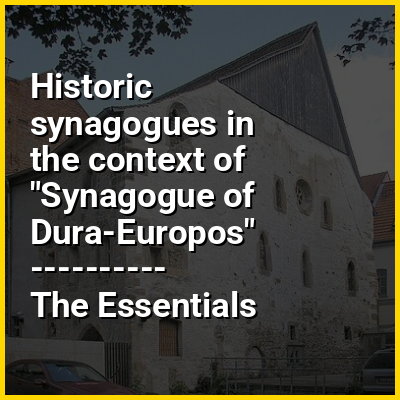
HINT:
In this Dossier
Historic synagogues in the context of Dura-Europos synagogue
The Dura-Europos synagogue was an ancient Jewish synagogue discovered in 1932 at Dura-Europos, Syria. The synagogue contained a forecourt and house of assembly with painted walls depicting people and animals, and a Torah shrine in the western wall facing Jerusalem. It was built backing on to the city wall, which was important in its survival. The last phase of construction was dated by an Aramaic inscription to 244 CE, placing it among just a handful of synagogues from antiquity discovered and unequivocally identified by archaeologists. It was unique among the many ancient synagogues that have emerged from archaeological excavations as the structure was preserved virtually intact, and it had extensive figurative wall-paintings, which in 1932 still came as a considerable surprise to scholars. The synagogue remains, including the murals, are now preserved in the National Museum of Damascus.
Dura-Europos was a small garrison and trading city on the river Euphrates, and usually on the frontier between the Eastern Roman Empire and the Parthian and finally the Sassanid Empires of Persia. It changed hands at various points but was Roman from 165 AD. Before the final Persian destruction of the town in 256–257 AD, parts of the synagogue which abutted the main city wall were apparently requisitioned and filled with sand as a defensive measure. The city was abandoned after its fall and never resettled, and the lower walls of the rooms remained buried and largely intact until excavated. The short measure of time during which it was used ensured that it would have limited impact upon Jewish or Christian art. The excavations also discovered very important wall-paintings from places of worship of Christianity at the Dura-Europos church. In addition, there were wall paintings edifying Mithraism, and fragmentary Christian texts in Hebrew.
View the full Wikipedia page for Dura-Europos synagogue