Hindu Shahi in the context of "Utpala dynasty"

Play Trivia Questions online!

or

Skip to study material about Hindu Shahi in the context of "Utpala dynasty"


⭐ Core Definition: Hindu Shahi

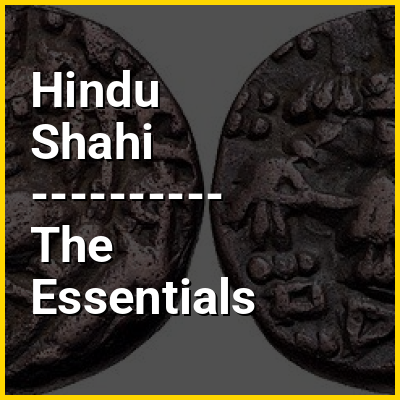
The Hindu Shahis, also referred to as the Kabul Shahis and Uḍi Śāhis, were a dynasty established between 843 CE and 1026 CE. They endured multiple waves of conquests for nearly two centuries and their core territory was described as having contained the regions of Gandhara and in current Eastern Afghanistan, encompassing the area up to the Sutlej river in modern day Punjab, expanding into the Kangra Valley. The empire was founded by Kallar in c. 843 CE after overthrowing Lagaturman, the last Turk Shahi king.

The history of the Hindu Shahis begins in 843 CE with Kallar deposing the last Turk Shahi ruler, Lagaturman. Samanta succeeded him, and it was during his reign that the region of Kabul was lost to the Persianate Saffarid dynasty. Lalliya replaced Samanta soon after and re-conquered Kabul whilst also subduing the region of Zabulistan. He is additionally noteworthy for coming into conflict with Samkaravarman of the Utpala dynasty, resulting in his victory and the latter's death in Hazara. Bhimadeva, the next notable ruler, is most significant for vanquishing the Samanid Empire in Ghazni and Kabul in response to their conquests. Jayapala then gained control and was brought into conflict with the newly formed Ghaznavid Empire, however, he was eventually defeated. During his rule and that of his son and successor, Anandapala, the kingdom of Lahore was conquered. The following Shahi rulers all resisted the Ghaznavids but were ultimately unsuccessful, resulting in the downfall of the empire in 1026 CE.
↓ Menu

In this Dossier

Hindu Shahi in the context of Lahore

Lahore is the capital and largest city of the Pakistani province of Punjab. It is the second-largest city in Pakistan, after Karachi, and 27th largest in the world, with a population of over 14 million. Lahore is one of Pakistan's major industrial, educational and economic hubs. It has been the historic capital and cultural centre of the wider Punjab region, and is one of Pakistan's most socially liberal, progressive, and cosmopolitan cities.

Lahore's origin dates back to antiquity. The city has been inhabited for around two millennia, although it rose to prominence in the late 10th century with the establishment of the Walled City, its fortified interior. Lahore served as the capital of several empires during the mediaeval era, including the Hindu Shahis, Ghaznavid Empire and Delhi Sultanate. It reached the height of its splendour under the Mughal Empire between the late 16th and early 18th centuries, being its capital city for many years. During this period, it was one of the largest cities in the world. The city was captured by the forces of the Afsharid ruler Nader Shah in 1739. Although the Mughal authority was re-established, it fell into a period of decay while being contested among the Afghans and the Sikhs between 1748 and 1798, eventually becoming capital of the Sikh Empire in the early 19th century. Lahore was annexed to the British Raj in 1849 and became the capital of British Punjab. Lahore was central to the independence movements of British India, with the city being the site of both the Declaration of Indian Independence and the resolution calling for the establishment of Pakistan. It experienced some of the worst rioting during the partition of British India preceding Pakistan's establishment. Following the success of the Pakistan Movement and the subsequent partition in 1947, Lahore was declared the capital of Pakistan's Punjab province.

↑ Return to Menu

Hindu Shahi in the context of Khyber Pakhtunkhwa

Khyber Pakhtunkhwa, commonly abbreviated KP or KPK and formerly known as the North-West Frontier Province (NWFP), is a province of Pakistan. Located in the northwestern region of the country, Khyber Pakhtunkhwa is the fourth largest province of Pakistan by land area and the third-largest province by population. It is bordered by Balochistan to the south; Punjab, Islamabad Capital Territory, and Azad Kashmir to the east; and Gilgit-Baltistan to the north and northeast. It shares an international border with Afghanistan to the west. Khyber Pakhtunkhwa has a varied geography of rugged mountain ranges, valleys, rolling foothills, and dense agricultural farms.

The history of the present province of Khyber Pakhtunkhwa is characterized by frequent invasions by various empires, largely due to its geographical proximity to the historically important Khyber Pass. It was the site of the ancient Gandhara, and was historically a stronghold of Buddhism. Islam became dominant in the region after the 11th-century conquest of the Hindu Shahi kingdom by the Ghaznavids. The predecessor of the present province was constituted in 1901, under the British Raj, when the North-West Frontier Province was created by bifurcating the northwestern districts of the erstwhile Punjab Province.

↑ Return to Menu

Hindu Shahi in the context of Islam in Afghanistan

Sunni Islam (Hanafi/Deobandi) is the largest and the state religion of the Islamic Emirate of Afghanistan. Islam in Afghanistan began to be practiced after the Arab Islamic conquest of Afghanistan from the 7th to the 10th centuries, with the last holdouts to conversion submitting in the late 19th century. It was generally accepted by local communities as a replacement of Zoroastrianism and Buddhism, local tribes began converting to the new religion. Islam is the official state religion of Afghanistan, with approximately 99.7% of the Afghan population being Muslim. Roughly 85% practice Sunni Islam, while around 10% are Shias. Most Shias belong to the Twelver branch and only a smaller number follow Ismailism.

After the Islamic conquest of Persia was completed, the Muslim Arabs then began to move towards the lands east of Persia and in 652 captured Herat. By the end of the 10th century CE the Turkic Ghaznavids subdued Kabul Shahi kings.

↑ Return to Menu

Hindu Shahi in the context of Qila Mubarak, Bathinda

Qila Mubarak, also known as Gobindgarh, is a historical monument in the heart of the city of Bathinda in Punjab, India. It is recognised as monument of national importance and maintained by Archaeological Survey of India. It has been in existence from 1100 to 1200 AD in its current place and is the oldest surviving fort in India. It was here that Razia Sultan, the first woman to take charge of the Delhi throne was incarcerated upon her defeat and dethroned. The bricks of the fort date back to the Kushana period when emperor Kanishka ruled over Northern India/Bactria. Raja Dab, along with emperor Kanishka, is believed to have built the fort. Qila Mubarak in latter part of the 10th Century was under the rule of Jayapala, a ruler of the Hindu Shahi dynasty.

↑ Return to Menu

Hindu Shahi in the context of Battle of Peshawar (1001)

The Battle of Peshawar was fought on 27 November 1001 between the Ghaznavid army of Mahmud of Ghazni and the Hindu Shahi army of Jayapala, near Peshawar. Jayapala was defeated and captured, and as a result of the humiliation of the defeat, he later immolated himself in a funeral pyre. This is the first of many major battles in the expansion of the Ghaznavid Empire into the Indian subcontinent by Mahmud.

↑ Return to Menu