Higgs field in the context of "Coupling (physics)"

Play Trivia Questions online!

or

Skip to study material about Higgs field in the context of "Coupling (physics)"

Ad spacer

⭐ Core Definition: Higgs field

The Higgs boson, sometimes called the Higgs particle, is an elementary particle in the Standard Model of particle physics produced by the quantum excitation of the Higgs field, one of the fields in particle physics theory. In the Standard Model, the Higgs particle is a massive scalar boson that couples to (interacts with) particles whose mass arises from their interactions with the Higgs Field, has zero spin, even (positive) parity, no electric charge, and no colour charge. It is also very unstable, decaying into other particles almost immediately upon generation.

The Higgs field is a scalar field with two neutral and two electrically charged components that form a complex doublet of the weak isospin SU(2) symmetry. Its "sombrero potential" leads it to take a nonzero value everywhere (including otherwise empty space), which breaks the weak isospin symmetry of the electroweak interaction and, via the Higgs mechanism, gives a rest mass to all massive elementary particles of the Standard Model, including the Higgs boson itself. The existence of the Higgs field became the last unverified part of the Standard Model of particle physics, and for several decades was considered "the central problem in particle physics".

↓ Menu

>>>PUT SHARE BUTTONS HERE<<<
In this Dossier

Higgs field in the context of Scalar field theory

In theoretical physics, scalar field theory can refer to a relativistically invariant classical or quantum theory of scalar fields. A scalar field is invariant under any Lorentz transformation.

The only fundamental scalar quantum field that has been observed in nature is the Higgs field. However, scalar quantum fields feature in the effective field theory descriptions of many physical phenomena. An example is the pion, which is actually a pseudoscalar.

↑ Return to Menu

Higgs field in the context of Top quark

The top quark, sometimes also referred to as the truth quark, (symbol: t) is the most massive of all observed elementary particles. It derives its mass from its coupling to the Higgs field. This coupling yt is very close to unity; in the Standard Model of particle physics, it is the largest (strongest) coupling at the scale of the weak interactions and above. The top quark was discovered in 1995 by the CDF and experiments at Fermilab.

Like all other quarks, the top quark is a fermion with spin-1/2 and participates in all four fundamental interactions: gravitation, electromagnetism, weak interactions, and strong interactions. It has an electric charge of + 2 /3 e. It has a mass of 172.76±0.3 GeV/c, which is close to the rhenium atom mass (more precisely, the average of its isotopes). The antiparticle of the top quark is the top antiquark (symbol: t, sometimes called antitop quark or simply antitop), which differs from it only in that some of its properties have equal magnitude but opposite sign.

↑ Return to Menu

Higgs field in the context of Scalar-valued function

In mathematics and physics, a scalar field is a function associating a single number to each point in a region of space – possibly physical space. The scalar may either be a pure mathematical number (dimensionless) or a scalar physical quantity (with units).

In a physical context, scalar fields are required to be independent of the choice of reference frame. That is, any two observers using the same units will agree on the value of the scalar field at the same absolute point in space (or spacetime) regardless of their respective points of origin. Examples used in physics include the temperature distribution throughout space, the pressure distribution in a fluid, and spin-zero quantum fields, such as the Higgs field. These fields are the subject of scalar field theory.

↑ Return to Menu

Higgs field in the context of Weak hypercharge

In the Standard Model of electroweak interactions of particle physics, the weak hypercharge is a quantum number relating the electric charge and the third component of weak isospin. It is frequently denoted and corresponds to the gauge symmetry U(1).

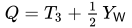
It is conserved (only terms that are overall weak-hypercharge neutral are allowed in the Lagrangian). However, one of the interactions is with the Higgs field. Since the Higgs field vacuum expectation value is nonzero, particles interact with this field all the time even in vacuum. This changes their weak hypercharge (and weak isospin T3). Only a specific combination of them, (electric charge), is conserved.

↑ Return to Menu

Higgs field in the context of Electroweak scale

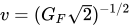
In particle physics, the electroweak scale, also known as the Fermi scale, is the energy scale around 246 GeV, a typical energy of processes described by the electroweak theory. The particular number 246 GeV is taken to be the vacuum expectation value of the Higgs field (where is the Fermi coupling constant). In some cases the term electroweak scale is used to refer to the temperature of electroweak symmetry breaking, 159.5±1.5 GeV. In other cases, the term is used more loosely to refer to energies in a broad range around 10 - 10 GeV. This is within reach of the Large Hadron Collider (LHC), which is designed for about 10 GeV in proton–proton collisions.

Interactions may have been above this scale during the electroweak epoch. In the unextended Standard Model, the transition from the electroweak epoch was not a first or a second order phase transition but a continuous crossover, preventing any baryogenesis. However many extensions to the standard model including supersymmetry and the inert double model have a first order electroweak phase transition (but still lack additional CP violation).

↑ Return to Menu