A Hertzsprung–Russell diagram (abbreviated as H–R diagram, HR diagram or HRD) is a scatter plot of stars showing the relationship between the stars' absolute magnitudes or luminosities and their stellar classifications or effective temperatures. It is also sometimes called a color magnitude diagram. The diagram was created independently in 1911 by Ejnar Hertzsprung and by Henry Norris Russell in 1913, and represented a major step towards an understanding of stellar evolution.
>>>PUT SHARE BUTTONS HERE<<<
In this Dossier
- ⭐ Core Definition: Hertzsprung–Russell diagram
- Hertzsprung–Russell diagram in the context of Supergiant
- Hertzsprung–Russell diagram in the context of Main sequence
- Hertzsprung–Russell diagram in the context of Blue supergiant star
- Hertzsprung–Russell diagram in the context of Giant star
- Hertzsprung–Russell diagram in the context of Classical Cepheid variable
- Hertzsprung–Russell diagram in the context of Stellar pulsation
- Hertzsprung–Russell diagram in the context of Asymptotic giant branch
- Hertzsprung–Russell diagram in the context of Pre-main-sequence star
Hertzsprung–Russell diagram in the context of Supergiant
Supergiants are among the most massive and most luminous stars. Supergiant stars occupy the top region of the Hertzsprung–Russell diagram, with absolute visual magnitudes between about −3 and −8. The temperatures of supergiant stars range from about 3,400 K to over 20,000 K.
Hertzsprung–Russell diagram in the context of Main sequence
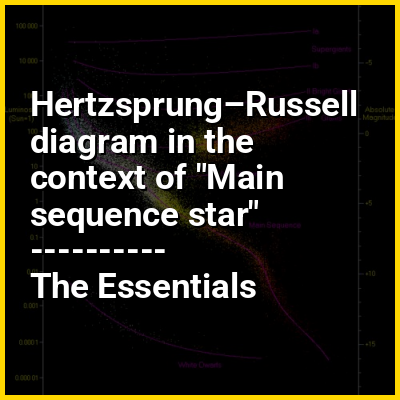
In astrophysics, the main sequence is a classification of stars which appear on plots of stellar color versus brightness as a continuous and distinctive band. Stars spend the majority of their lives on the main sequence, during which core hydrogen burning is dominant. These main-sequence stars, or sometimes interchangeably dwarf stars, are the most numerous true stars in the universe and include the Sun. Color-magnitude plots are known as Hertzsprung–Russell diagrams after Ejnar Hertzsprung and Henry Norris Russell.
When a gaseous nebula undergoes sufficient gravitational collapse, the high pressure and temperature concentrated at the core will trigger the nuclear fusion of hydrogen into helium (see stars). The thermal energy from this process radiates out from the hot, dense core, generating a strong pressure gradient. It is this pressure gradient that counters the star's collapse under gravity, maintaining the star in a state of hydrostatic equilibrium. The star's position on the main sequence is determined primarily by the mass, but also by age and chemical composition. As a result, radiation is not the only method of energy transfer in stars. Convection plays a role in the movement of energy, particularly in the cores of stars greater than 1.3 to 1.5 times the Sun's mass, again depending on age and chemical composition.
Hertzsprung–Russell diagram in the context of Blue supergiant star
A blue supergiant (BSG) is a hot, luminous star, often referred to as an OB supergiant. They are usually considered to be those with luminosity class I and spectral class B9 or earlier, although sometimes A-class supergiants are also deemed blue supergiants.
Blue supergiants are found towards the top left of the Hertzsprung–Russell diagram, above and to the right of the main sequence. By analogy to the red giant branch for low-mass stars, this region is also called the blue giant branch. They are larger than the Sun but smaller than a red supergiant, with surface temperatures of 10,000–50,000 K and luminosities from about 10,000 to a million times that of the Sun. They are most often an evolutionary phase between high-mass, hydrogen-fusing main-sequence stars and helium-fusing red supergiants, although new research suggests they could be the result of stellar mergers.
Hertzsprung–Russell diagram in the context of Giant star
A giant star has a substantially larger radius and luminosity than a main-sequence (or dwarf) star of the same surface temperature. They lie above the main sequence (luminosity class V in the Yerkes spectral classification) on the Hertzsprung–Russell diagram and correspond to luminosity classes II and III. The terms giant and dwarf were coined for stars of quite different luminosity despite similar temperature or spectral type (namely K and M) by Ejnar Hertzsprung in 1905 or 1906.
Giant stars have radii up to a few hundred times the Sun and luminosities over 10 times that of the Sun. Stars still more luminous than giants are referred to as supergiants and hypergiants.
Hertzsprung–Russell diagram in the context of Classical Cepheid variable
Classical Cepheids are a type of Cepheid variable star. They are young, population I variable stars that exhibit regular radial pulsations with periods of a few days to a few weeks and visual amplitudes ranging from a few tenths of a magnitude up to about 2 magnitudes. Classical Cepheids are also known as Population I Cepheids, Type I Cepheids, and Delta Cepheid variables.
There exists a well-defined relationship between a classical Cepheid variable's luminosity and pulsation period, securing Cepheids as viable standard candles for establishing the galactic and extragalactic distance scales. Hubble Space Telescope (HST) observations of classical Cepheid variables have enabled firmer constraints on Hubble's law, which describes the expansion rate of the observable Universe. Classical Cepheids have also been used to clarify many characteristics of our galaxy, such as the local spiral arm structure and the Sun's distance from the galactic plane.
Hertzsprung–Russell diagram in the context of Stellar pulsation
Stellar pulsations are caused by expansions and contractions in the outer layers as a star seeks to maintain equilibrium. These fluctuations in stellar radius cause corresponding changes in the luminosity of the star. Astronomers are able to deduce this mechanism by measuring the spectrum and observing the Doppler effect. Many intrinsic variable stars that pulsate with large amplitudes, such as the classical Cepheids, RR Lyrae stars and large-amplitude Delta Scuti stars show regular light curves.
This regular behavior is in contrast with the variability of stars that lie parallel to and to the high-luminosity/low-temperature side of the classical variable stars in the Hertzsprung–Russell diagram. These giant stars are observed to undergo pulsations ranging from weak irregularity, when one can still define an average cycling time or period, (as in most RV Tauri and semiregular variables) to the near absence of repetitiveness in the irregular variables. The W Virginis variables are at the interface; the short period ones are regular and the longer period ones show first relatively regular alternations in the pulsationscycles, followed by the onset of mild irregularity as in the RV Tauri stars into which they gradually morph as their periods get longer. Stellar evolution and pulsation theories suggest that these irregular stars have a much higher luminosity to mass (L/M) ratios.
Hertzsprung–Russell diagram in the context of Asymptotic giant branch
The asymptotic giant branch (AGB) is a region of the Hertzsprung–Russell diagram populated by evolved cool luminous stars. This is a period of stellar evolution undertaken by all low- to intermediate-mass stars (about 0.5 to 8 solar masses) late in their lives.
Observationally, an asymptotic-giant-branch star will appear as a bright red giant with a luminosity ranging up to thousands of times greater than the Sun. Its interior structure is characterized by a central and largely inert core of carbon and oxygen, a shell where helium is undergoing fusion to form carbon (known as helium burning), another shell where hydrogen is undergoing fusion forming helium (known as hydrogen burning), and a very large envelope of material of composition similar to main-sequence stars (except in the case of carbon stars).
Hertzsprung–Russell diagram in the context of Pre-main-sequence star
A pre-main-sequence star (also known as a PMS star and PMS object) is a star in the stage when it has not yet reached the main sequence. Earlier in its life, the object is a protostar that grows by acquiring mass from its surrounding envelope of interstellar dust and gas. After the protostar blows away this envelope, it is optically visible, and appears on the stellar birthline in the Hertzsprung-Russell diagram. At this point, the star has acquired nearly all of its mass but has not yet started hydrogen burning (i.e. nuclear fusion of hydrogen). The star continues to contract, its internal temperature rising until it begins hydrogen burning on the zero age main sequence. This period of contraction is the pre-main sequence stage. An observed PMS object can either be a T Tauri star, if it has fewer than 2 solar masses (M☉), or else a Herbig Ae/Be star, if it has 2 to 8 M☉. Yet more massive stars have no pre-main-sequence stage because they contract too quickly as protostars. By the time they become visible, the hydrogen in their centers is already fusing and they are main-sequence objects.
The energy source of PMS objects is gravitational contraction, as opposed to hydrogen burning in main-sequence stars. In the Hertzsprung–Russell diagram, pre-main-sequence stars with more than 0.5 M☉ first move vertically downward along Hayashi tracks, then leftward and horizontally along Henyey tracks, until they finally halt at the main sequence. Pre-main-sequence stars with less than 0.5 M☉ contract vertically along the Hayashi track for their entire evolution.