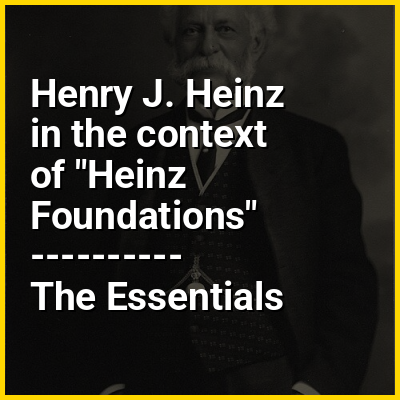
Henry John Heinz (October 11, 1844 – May 14, 1919) was an American entrepreneur who co-founded the H. J. Heinz Company of Pittsburgh, Pennsylvania. He was involved in the passage of the 1906 Pure Food and Drug Act. Many of his descendants are known for philanthropy and involvement in politics and public affairs. His fortune became the basis for the Heinz Foundations.
HINT:
In this Dossier
- ⭐ Core Definition: Henry J. Heinz
- Henry J. Heinz in the context of Downtown Pittsburgh
- Henry J. Heinz in the context of H. J. Heinz Company
Henry J. Heinz in the context of Downtown Pittsburgh
Downtown Pittsburgh, colloquially referred to as the Golden Triangle, and officially the Central Business District, is the urban downtown center of Pittsburgh, Pennsylvania, United States. It is located at the confluence of the Allegheny River and the Monongahela River whose joining forms the Ohio River. The triangle is bounded by the two rivers.
The area features offices for major corporations such as PNC Bank, U.S. Steel, PPG, Bank of New York Mellon, Heinz, Federated Investors, and Alcoa. It is where the fortunes of such industrial barons as Andrew Carnegie, Henry Clay Frick, Henry J. Heinz, Andrew Mellon and George Westinghouse were made. It contains the site where the French fort, Fort Duquesne, once stood.
View the full Wikipedia page for Downtown PittsburghHenry J. Heinz in the context of H. J. Heinz Company
The H. J. Heinz Company, commonly known as Heinz (/haɪnz/), was an American food processing company headquartered at One PPG Place in Pittsburgh, Pennsylvania. The company was founded by Henry J. Heinz in 1869. Heinz manufactured food products on six continents, and marketed them in more than 200 countries and territories. The company claimed to have 150 number-one or number-two brands worldwide as of 2013. Heinz ranked first in ketchup in the US with a market share in excess of 50%; the Ore-Ida label held 46% of the frozen potato sector in 2003.
Since 1896, the company used its "57 Varieties" slogan; it was inspired by a sign advertising 21 styles of shoes, and Henry Heinz chose the number 57 even though the company then manufactured more than 60 products, because "5" was his lucky number and "7" was his wife's.
View the full Wikipedia page for H. J. Heinz Company