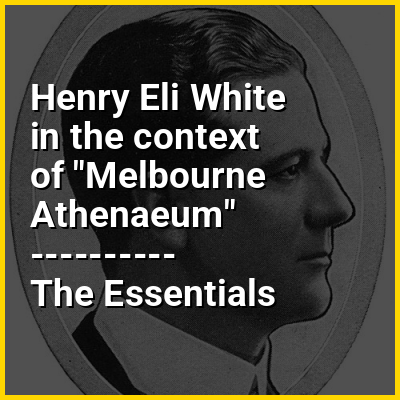
Henry Eli White (21 August 1876 – 3 March 1952), also known as Harry White, was a New Zealand-born architect best known for the many theatres and cinemas he designed in New Zealand and Australia in the 1910s and 1920s. Many of the major surviving historic venues in the two countries are White designs, including the St. James Theatre, Wellington, St. James Theatre, Auckland, the Capitol Theatre and State Theatre in Sydney, and the Palais Theatre and the interiors of the Princess Theatre and Athenaeum Theatre in Melbourne. He also designed the City Hall and the attached Civic Theatre in Newcastle, New South Wales.
HINT:
In this Dossier
- ⭐ Core Definition: Henry Eli White
- Henry Eli White in the context of Atmospheric theatre
- Henry Eli White in the context of Capitol Theatre, Sydney
- Henry Eli White in the context of State Theatre (Sydney)
Henry Eli White in the context of Atmospheric theatre
An atmospheric theatre is a type of movie palace design which was popular in the late 1920s. Atmospheric theatres were designed and decorated to evoke the feeling of a particular time and place for patrons, through the use of projectors, architectural elements and ornamentation that evoked a sense of being outdoors. This was intended to make the patron a more active participant in the setting.
The most successful promoter of the style was John Eberson. He credited the Hoblitzelle Majestic Theatre (Houston, 1923, since demolished) as the first. Before the end of the 1920s he designed around 100 atmospheric theatres in the U.S. and a few other countries, personally selecting the furnishings and art objects. His most notable surviving theatres in the United States include the Tampa Theatre (1926), Palace Theatre (1928), Majestic Theatre (1929), Paramount Theatre (1929), and the Loew's Theatre (1929). Remaining international examples include The Civic Theatre (1929, Auckland, New Zealand), The Forum (1929, Melbourne, Australia), as well as two theatres completed in Sydney, Australia, the Capitol Theatre (1928) and State Theatre (1929) (both designed by Henry Eli White with assistance from Eberson), and Le Grand Rex, (1932, Paris, France) which was designed by architect Auguste Bluysen with assistance from Eberson.
View the full Wikipedia page for Atmospheric theatreHenry Eli White in the context of Capitol Theatre, Sydney
The Capitol Theatre is a heritage-listed theatre located at 3–15 Campbell Street, Haymarket, in the Sydney central business district, Australia. It was designed by Henry Eli White and John Eberson and built from 1893 to 1928. The property was added to the New South Wales State Heritage Register on 2 April 1999. The former circus venue, atmospheric theatre and market venue is owned by Capitol Theatre Management Pty Limited, a wholly owned subsidiary of Foundation Theatres Pty Limited, which also owns the Sydney Lyric.
View the full Wikipedia page for Capitol Theatre, SydneyHenry Eli White in the context of State Theatre (Sydney)
The State Theatre is a 2,034 seat heritage listed theatre located at 47–51 Market Street, in the Sydney central business district in the City of Sydney local government area of New South Wales, Australia. The theatre was designed by Henry Eli White with assistance from John Eberson and built between 1926 and 1929. It hosts film screenings, live theatre and musical performances, and since 1974 it has been the home of the annual Sydney Film Festival. It is also known as State Building and Wurlitzer Organ. The property is privately owned. It was added to the New South Wales State Heritage Register on 2 April 1999.
The State Theatre is a tiered and raked theatre with a proscenium arch and a maximum seating capacity of 2034 seats. The seating is arranged with 828 seats in the Stalls at stage level, 426 in the Mezzanine Lounge and 780 seats in the Dress Circle (upper most level).
View the full Wikipedia page for State Theatre (Sydney)