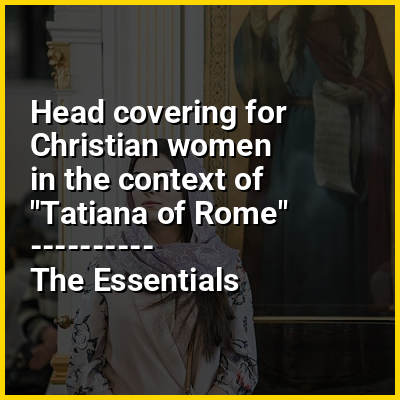
Christian head covering, also known as Christian veiling, is the traditional practice of women covering their head in a variety of Christian denominations. Some Christian women wear the head covering in public worship and during private prayer at home, while others (particularly Conservative Anabaptists) believe women should wear head coverings at all times. Many theologians of the Oriental and Eastern Orthodox Churches likewise teach that it is "expected of all women to be covered not only during liturgical periods of prayer, but at all times, for this was their honor and sign of authority given by our Lord", while others have held that headcovering should at least be done during prayer and worship. Genesis 24:65 records the veil as a feminine emblem of modesty.
Manuals of early Christianity, including the Didascalia Apostolorum and Pædagogus, instructed that a headcovering must be worn by women during prayer and worship as well as when outside the home. When Paul the Apostle commanded women to be veiled in 1 Corinthians, the surrounding pagan Greek women did not wear head coverings; as such, the practice of Christian headcovering was countercultural in the Apostolic Era, being a biblical ordinance rather than a cultural tradition. The style of headcovering varies by region, though Apostolic Tradition specifies an "opaque cloth, not with a veil of thin linen".