Hayashi track in the context of Hertzsprung–Russell diagram


Hayashi track in the context of Hertzsprung–Russell diagram

⭐ Core Definition: Hayashi track

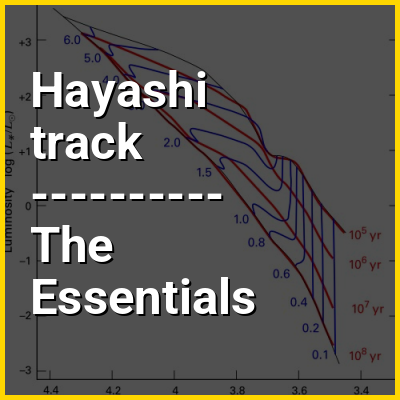
The Hayashi track is a luminosity–temperature relationship obeyed by infant stars of less than 3 M in the pre-main-sequence phase (PMS phase) of stellar evolution. It is named after Japanese astrophysicist Chushiro Hayashi (1920-2010). On the Hertzsprung–Russell diagram, which plots luminosity against temperature, the track is a nearly vertical curve. After a protostar ends its phase of rapid contraction and becomes a T Tauri star, it is extremely luminous. The star continues to contract, but much more slowly. While slowly contracting, the star follows the Hayashi track downwards, becoming several times less luminous but staying at roughly the same surface temperature, until either a radiative zone develops, at which point the star starts following the Henyey track, or nuclear fusion begins, marking its entry onto the main sequence.

The shape and position of the Hayashi track on the Hertzsprung–Russell diagram depends on the star's mass and chemical composition. For solar-mass stars, the track lies at a temperature of roughly 4000 K. Stars on the track are nearly fully convective and have their opacity dominated by hydrogen ions. Stars less than 0.5 M are fully convective even on the main sequence, but their opacity begins to be dominated by Kramers' opacity law after nuclear fusion begins, thus moving them off the Hayashi track. Stars between 0.5 and 3 M develop a radiativezone prior to reaching the main sequence. Stars between 3 and 10 M are fully radiative at the beginning of the pre-main-sequence. Even heavier stars are born onto the main sequence, with no PMS evolution.
↓ Menu
HINT:

In this Dossier

Hayashi track in the context of T Tauri star

T Tauri stars (TTS) are a class of variable stars that are less than about ten million years old. This class is named after the prototype, T Tauri, a young star in the Taurus star-forming region. They are found near molecular clouds and identified by their optical variability and strong chromospheric lines. T Tauri stars are pre-main-sequence stars in the process of contracting to the main sequence along the Hayashi track, a luminosity–temperature relationship obeyed by infant stars of less than 3 solar masses (M) in the pre-main-sequence phase of stellar evolution. It ends when a star of 0.5 M or larger develops a radiative zone, or when a smaller star commences nuclear fusion on the main sequence.

View the full Wikipedia page for T Tauri star
↑ Return to Menu

Hayashi track in the context of Pre-main-sequence star

A pre-main-sequence star (also known as a PMS star and PMS object) is a star in the stage when it has not yet reached the main sequence. Earlier in its life, the object is a protostar that grows by acquiring mass from its surrounding envelope of interstellar dust and gas. After the protostar blows away this envelope, it is optically visible, and appears on the stellar birthline in the Hertzsprung-Russell diagram. At this point, the star has acquired nearly all of its mass but has not yet started hydrogen burning (i.e. nuclear fusion of hydrogen). The star continues to contract, its internal temperature rising until it begins hydrogen burning on the zero age main sequence. This period of contraction is the pre-main sequence stage. An observed PMS object can either be a T Tauri star, if it has fewer than 2 solar masses (M), or else a Herbig Ae/Be star, if it has 2 to 8 M. Yet more massive stars have no pre-main-sequence stage because they contract too quickly as protostars. By the time they become visible, the hydrogen in their centers is already fusing and they are main-sequence objects.

The energy source of PMS objects is gravitational contraction, as opposed to hydrogen burning in main-sequence stars. In the Hertzsprung–Russell diagram, pre-main-sequence stars with more than 0.5 M first move vertically downward along Hayashi tracks, then leftward and horizontally along Henyey tracks, until they finally halt at the main sequence. Pre-main-sequence stars with less than 0.5 M contract vertically along the Hayashi track for their entire evolution.

View the full Wikipedia page for Pre-main-sequence star
↑ Return to Menu

Hayashi track in the context of Henyey track

The Henyey track is a path taken by pre-main-sequence stars with masses greater than 0.5 solar masses in the Hertzsprung–Russell diagram after the end of the Hayashi track. The astronomer Louis G. Henyey and his colleagues in the 1950s showed that the pre-main-sequence star can remain in radiative equilibrium throughout some period of its contraction to the main sequence.

The Henyey track is characterized by a slow collapse in near hydrostatic equilibrium, approaching the main sequence almost horizontally in the Hertzsprung–Russell diagram (i.e. the luminosity remains almost constant).

View the full Wikipedia page for Henyey track
↑ Return to Menu

Hayashi track in the context of Stellar isochrone

In stellar evolution, an isochrone is a curve on the Hertzsprung-Russell diagram, representing a population of stars of the same age but with different mass.

The Hertzsprung-Russell diagram plots a star's luminosity against its temperature, or equivalently, its color. Stars change their positions on the HR diagram throughout their life. Newborn stars of low or intermediate mass are born cold but extremely luminous. They contract and dim along the Hayashi track, decreasing in luminosity but staying at roughly the same temperature, until reaching the main sequence directly or by passing through the Henyey track. Stars evolve relatively slowly along the main sequence as they fuse hydrogen, and after the vast majority of their lifespan, all but the least massive stars become giants. They then evolve quickly towards their stellar endpoints: white dwarfs, neutron stars, or black holes.

View the full Wikipedia page for Stellar isochrone
↑ Return to Menu

Hayashi track in the context of Chushiro Hayashi

Chushiro Hayashi (林 忠四郎, Hayashi Chūshirō; July 25, 1920 – February 28, 2010) was a Japanese astrophysicist. Hayashi tracks on the Hertzsprung–Russell diagram are named after him.

View the full Wikipedia page for Chushiro Hayashi
↑ Return to Menu