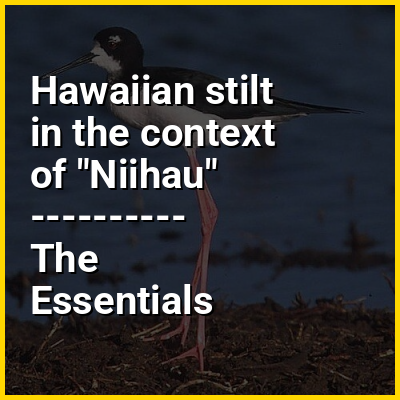
The Hawaiian stilt (Himantopus mexicanus knudseni) is an endangered Hawaiian subspecies of the black-necked stilt (H. mexicanus) species. It is a long-legged, slender shorebird with a long, thin beak. Other common names include the Hawaiian black-necked stilt, the aeʻo (from a Hawaiian name for the bird and word for stilts), the kukuluaeʻo (a Hawaiian name for the bird and word for “one standing high”), or it may be referred to as the Hawaiian subspecies of the black-necked stilt.
HINT:
In this Dossier
Hawaiian stilt in the context of Niʻihau
Niʻihau, sometimes written Niihau, is the seventh largest island in Hawaii and the westernmost of the main islands. It is 17.5 miles (28.2 km) southwest of Kauaʻi across the Kaulakahi Channel. Its area is 69.5 square miles (180 km). Several intermittent playa lakes provide wetland habitats for the Hawaiian coot, the Hawaiian stilt, and the Hawaiian duck. The island is designated as critical habitat for Brighamia insignis, an endemic and endangered species of Hawaiian lobelioid. The United States Census Bureau defines Niihau and the neighboring island and State Seabird Sanctuary of Lehua as Census Tract 410 of Kauaʻi County, Hawaii. Its 2010 census population was 170, most of them native Hawaiians. As of the 2020 census, the population had fallen to 84. The people of Niʻihau are noted for their gemlike lei pūpū (shell lei) craftsmanship. They speak Hawaiian as a primary language.
Elizabeth Sinclair purchased Niʻihau in 1864 for US$10,000 from the Kingdom of Hawaiʻi. The island's private ownership passed on to her descendants, the Robinsons.
View the full Wikipedia page for Niʻihau