Hashid in the context of South Arabian alphabet


Hashid in the context of South Arabian alphabet

⭐ Core Definition: Hashid

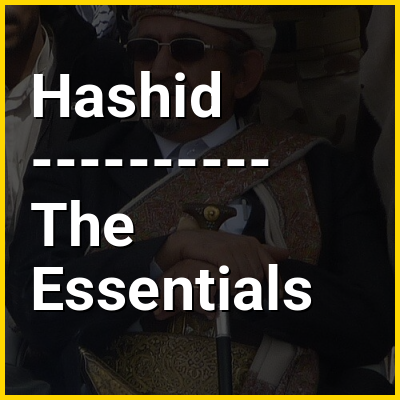
The Hashid (Arabic: حاشد; Musnad: 𐩢𐩦𐩵𐩣) is a tribal confederation in Yemen. It is the second or third largest – after Bakil and, depending on sources, Madh'hij – yet generally recognized as the strongest and most influential. According to medieval Yemeni genealogies, Hashid and Bakil were the sons of Jashim bin Jubran bin Nawf Bin Tuba'a bin Zayd bin Amr bin Hamdan. Member tribes of the Hashid Confederation are found primarily in the mountains in the North and Northwest of the country.

In recent times, Hashid confederation had for decades been led by the powerful Abushawareb clan. The clan's influence was built on an alliance with the former President Ali Abdullah Saleh, who relied on a coalition with the most prominent leader of the Hashid tribal confederation, Sheikh Abdullah ibn Husayn al-Ahmar, to take power in 1978. Until his death on 29 December 2007, Sheikh Abdullah served as the Speaker of Parliament and was considered Yemen's second most powerful person after President Saleh (who, along with many others in the government, also is a member of a Hashid tribe).
↓ Menu
HINT:

In this Dossier

Hashid in the context of Kingdom of Aksum

The Kingdom of Aksum, or the Aksumite Empire, was a kingdom in East Africa and South Arabia from classical antiquity to the Middle Ages, based in what is now northern Ethiopia and Eritrea, and spanning present-day Djibouti and Sudan. Emerging from the earlier Dʿmt civilization, the kingdom was founded in the first century. The city of Axum served as the kingdom's capital for many centuries until it relocated to Kubar in the ninth century due to declining trade connections and recurring invasions.

The Kingdom of Aksum was considered one of the four great powers of the third century by Mani, the one who started the Manichean movement, alongside Persia, Rome, and China. Aksum continued to expand under the reign of Gedara (c. 200–230), who was the first king to be involved in South Arabian affairs. His reign resulted in the control of much of western Yemen, such as the Tihama, Najran, al-Ma'afir, Zafar (until c. 230), and parts of Hashid territory around Hamir in the northern highlands until a joint Himyarite-Sabean alliance pushed them out. Aksum-Himyar conflicts persisted throughout the third century. During the reign of Endybis (270–310), Aksum began minting coins that have been excavated as far away as Caesarea and southern India.

View the full Wikipedia page for Kingdom of Aksum
↑ Return to Menu

Hashid in the context of Khamir, Yemen

Khamir (Arabic: خمر, romanizedKhamir) is a small city in the 'Amran Governorate of Yemen. It is the seat of Khamir District. It is now closely associated with the tribal confederation of Hashid, although it is named after a member of the Bakil tribe and was historically mainly a Bakil town.

View the full Wikipedia page for Khamir, Yemen
↑ Return to Menu

Hashid in the context of Aksumites

The Kingdom of Aksum, or the Aksumite Empire, was a kingdom in East Africa and South Arabia from classical antiquity to the Middle Ages, based in what is now northern Ethiopia and Eritrea, and spanning present-day Djibouti, Sudan, and Yemen. Emerging from the earlier Dʿmt civilization, the kingdom was founded in the 1st century. The city of Axum served as the kingdom's capital for many centuries until it relocated to Kubar in the 9th century due to declining trade connections and recurring invasions.

The Kingdom of Aksum was considered one of the four great powers of the 3rd century by Mani, the founder of Manichaeism, alongside Persia, Rome, and China. Aksum continued to expand under the reign of Gedara (c. 200–230), who was the first king to be involved in South Arabian affairs. His reign resulted in the control of much of western Yemen, such as the Tihama, Najran, al-Ma'afir, Zafar (until c. 230), and parts of Hashid territory around Hamir in the northern highlands until a joint Himyarite-Sabean alliance pushed them out. Aksum-Himyar conflicts persisted throughout the 3rd century. During the reign of Endybis (270–310), Aksum began minting coins that have been excavated as far away as Caesarea and southern India.

View the full Wikipedia page for Aksumites
↑ Return to Menu

Hashid in the context of Bakil

The Bakil (Arabic: بكيل, Musnad: 𐩨𐩫𐩺𐩡) federation is the largest tribal federation in Yemen. The tribe consists of more than 10 million men and women. As a subtribe of the Banu Hamdan, they are the sister tribe of the Hashid (4 million people) whose leader was Abdullah Bin Hussein Alahmar. The member tribes of the Bakil Confederation are found primarily in the far north of the country. Its current leaders are the Alshaif family, led by Naji bin Abdulaziz Alshaif.

View the full Wikipedia page for Bakil
↑ Return to Menu

Hashid in the context of Abdullah ibn Husayn al-Ahmar

Abdullah ibn Husayn ibn Nasser al-Ahmar (Arabic: عبد الله بن حسين بن ناصر الأحمر‎) (1 November 1933 – 29 December 2007) was a Yemeni politician and tribal leader. He was the Speaker of the House of Representatives (Yemen) from 1993 to 2007 and also the Sheikh of the Hashid tribal federation and the Al-Islah party.

He inherited the position of Sheikh (elder) of the Hashid tribal federation from his father, Husayn Bin Nasser al-Ahmar, who was executed by Imam Ahmad bin Yahya. As a result, during the North Yemen Civil War Abdullah al-Ahmar sided with the Republicans against the Royalists and was appointed governor of Hajjah, but he refused to join the Egyptian-backed government of Abdullah as-Sallal. After Egypt withdrew from Yemen, he helped topple the Sallal government and his tribes provided crucial support to the new regime of Abdul Rahman al-Iryani against the Royalists.

View the full Wikipedia page for Abdullah ibn Husayn al-Ahmar
↑ Return to Menu