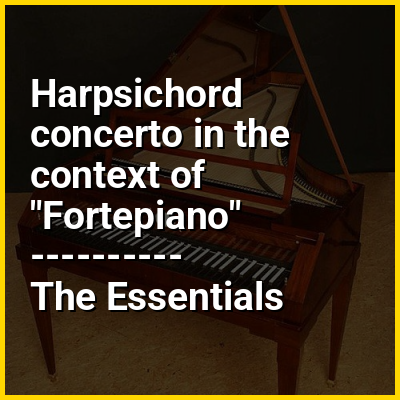
A harpsichord concerto is a piece of music for an orchestra with the harpsichord in a solo role (though for another sense, see below). Sometimes these works are played on the modern piano (see piano concerto). For a period in the late 18th century, Joseph Haydn and Thomas Arne wrote concertos that could be played interchangeably on harpsichord, fortepiano, and (in some cases) pipe organ.
HINT:
In this Dossier
- ⭐ Core Definition: Harpsichord concerto
- Harpsichord concerto in the context of Concerto
- Harpsichord concerto in the context of Piano concerto
Harpsichord concerto in the context of Concerto
A concerto (/kənˈtʃɛərtoʊ/; plural concertos, or concerti from the Italian plural) is, from the late Baroque era, mostly understood as an instrumental composition, written for one or more soloists accompanied by an orchestra or other ensemble. The typical three-movement structure, a slow movement (e.g., lento or adagio) preceded and followed by fast movements (e.g., presto or allegro), became a standard from the early 18th century.
The concerto originated as a genre of vocal music in the late 16th century: the instrumental variant appeared around a century later, when Italians such as Giuseppe Torelli and Arcangelo Corelli started to publish their concertos. A few decades later, Venetian composers, such as Antonio Vivaldi, had written hundreds of violin concertos, while also producing solo concertos for other instruments such as a cello or a woodwind instrument, and concerti grossi for a group of soloists. The first keyboard concertos, such as George Frideric Handel's organ concertos and Johann Sebastian Bach's harpsichord concertos, were written around the same time.
View the full Wikipedia page for ConcertoHarpsichord concerto in the context of Piano concerto
A piano concerto, a type of concerto, is a solo composition in the classical music genre which is composed for piano accompanied by an orchestra or other large ensemble. Piano concertos are typically virtuosic showpieces which require an advanced level of technique. Piano concertos are typically written out in music notation, including sheet music for the pianist (which is typically memorized for a more virtuosic performance), orchestral parts, and a full score for the conductor.
The standard practice in the Baroque and Classical eras (together spanning from circa 1600 to circa 1800), was for the orchestra to provide subordinate accompaniment over which the piano plays solo parts. However, at the end of the classical era, the orchestra had an equal role to the pianist and frequently had "dialogue" or "conversation" between the two. When music students and music competition auditionees play piano concertos, the orchestra part may be performed in an orchestral reduction, a conversion of the orchestra parts into a part for an accompanist playing piano or pipe organ, as it is very expensive to hire a full orchestra. Keyboard concerti were common in the time of Johann Sebastian Bach in the Baroque music era, during the Classical period and during the Romantic music era (1800–1910). Keyboard concertos are also written by contemporary classical music composers. Twentieth- and 21st-century piano concertos may include experimental or unusual performance techniques. In the 20th and 21st centuries, J. S. Bach's harpsichord concertos are sometimes played on piano. There are variant types of piano concertos, including double piano concertos, for two solo pianists and orchestra, and double or triple (or larger solo groups) concertos in which the piano soloist is joined by a violinist, cellist, or another instrumentalist.
View the full Wikipedia page for Piano concerto