Hampstead Heath in the context of "Heath"

Play Trivia Questions online!

or

Skip to study material about Hampstead Heath in the context of "Heath"

Ad spacer

⭐ Core Definition: Hampstead Heath

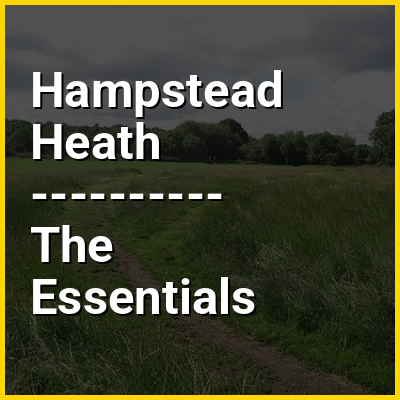
Hampstead Heath is an ancient heath in London, spanning 320 hectares (790 acres). This grassy public space sits astride a sandy ridge, one of the highest points in London, running from Hampstead to Highgate, which rests on a band of London Clay. The heath is rambling and hilly, embracing ponds, recent and ancient woodlands, a lido, playgrounds, and a training track, and it adjoins the former stately home of Kenwood House and its estate. The south-east part of the heath is Parliament Hill, from which the view over London is protected by law.

Running along its eastern perimeter is a chain of ponds – including three open-air public swimming pools – which were originally reservoirs for drinking water from the River Fleet. The heath is a Site of Metropolitan Importance for Nature Conservation, and part of Kenwood is a Site of Special Scientific Interest. Lakeside concerts are held there in summer. The heath is managed by the City of London Corporation, and lies mostly within the London Borough of Camden, with the adjoining Hampstead Heath Extension and Golders Hill Park in the London Borough of Barnet.
↓ Menu

>>>PUT SHARE BUTTONS HERE<<<
In this Dossier

Hampstead Heath in the context of London Borough of Camden

The London Borough of Camden (/ˈkæmdən/ ) is a borough in Inner London, England. Camden Town Hall, on Euston Road, lies 1.4 mi (2.3 km) north of Charing Cross. The borough was established on 1 April 1965 from the former metropolitan boroughs of Holborn, St Pancras and Hampstead.

To the south it shares with the City of Westminster parts of the West End, where it also borders the City of London. The cultural and commercial land uses in the south contrast with the bustling mixed-use districts such as Camden Town and Kentish Town in the centre and leafy residential areas around Hampstead Heath in the north. Well known attractions include The British Museum, The British Library, the famous views from Parliament Hill, the London Zoo, the BT Tower, the converted Roundhouse entertainment venue, and Camden Market. As of 2021 it has a population of 210,136. Politically, its local authority is Camden London Borough Council.

↑ Return to Menu

Hampstead Heath in the context of Kenwood House

Kenwood House (also known as the Iveagh Bequest) is a stately home in Hampstead, London, on the northern boundary of Hampstead Heath. The present house, built in the late 17th century, was remodelled in the 18th century for William Murray, 1st Earl of Mansfield by Scottish architect Robert Adam, serving as a residence for the Earls of Mansfield until the 20th century.

The house and part of the grounds were bought from the 6th Earl of Mansfield in 1925 by Edward Guinness, 1st Earl of Iveagh, and donated to the nation in 1927. The entire estate came under ownership of the London County Council and was open to the public by the end of the 1920s. It remains a popular local tourist attraction.

↑ Return to Menu

Hampstead Heath in the context of Kentish Town

Kentish Town is an area of northwest London, England, in the London Borough of Camden, immediately north of Camden Town, close to Hampstead Heath.

Kentish Town likely derives its name from Ken-ditch or Caen-ditch, meaning the "bed of a waterway." The area was initially a small settlement on the River Fleet, first recorded in 1207 during King John's reign. The early 19th century brought modernization to the area, and it became a popular resort due to its accessibility from London. Notably, Karl Marx resided at 46 Grafton Terrace in Kentish Town from 1856.

↑ Return to Menu

Hampstead Heath in the context of Parliament Hill, London

Parliament Hill is an area of open parkland in the south-east corner of Hampstead Heath in north-west London. The hill, which is 98 metres (322 ft) high, is notable for its views of the capital's skyline.

The Houses of Parliament, which are 6+14 miles (10.1 km) south of Parliament Hill in the City of Westminster, can be seen from the summit, although construction in the intermediate parts of London has partly obscured them.

↑ Return to Menu

Hampstead Heath in the context of Hampstead

Hampstead (/ˈhæmpstɪd, -stɛd/) is an area in London, England, which lies 4 miles (6.4 km) northwest of Charing Cross, located mainly in the London Borough of Camden, with a small part in the London Borough of Barnet. It borders Highgate and Golders Green to the north, Belsize Park to the south and is surrounded from the northeast by Hampstead Heath, a large, hilly expanse of parkland.

Hampstead is known for its intellectual, artistic, liberal, and literary associations. It contains a number of listed buildings, such as Burgh House, Kenwood House, the Spaniard's Inn, and the Everyman cinema. With some of the most expensive housing in London, Hampstead has had many notable residents, both past and present, including King Constantine II of Greece and his wife Queen Anne Marie, Helena Bonham Carter, Agatha Christie, T. S. Eliot, Jon English, Sigmund Freud, Stephen Fry, Ricky Gervais, Jim Henson, George Orwell, Harry Styles, Jedward, Tim Burton, Martin Freeman and Elizabeth Taylor. As of 2004, Hampstead has been home to more Prime Ministers, and contains more millionaires within its boundaries, than any other area of the United Kingdom.

↑ Return to Menu

Hampstead Heath in the context of Chair (sculpture)

Chair, also known as the Big Chair, is a public artwork designed as an advertisement by Bassett Furniture, located at the intersection of Martin Luther King Avenue and V Street S.E., in the Anacostia neighborhood of Washington, D.C., United States. Chair was originally surveyed as part of the Smithsonian's Save Outdoor Sculpture! survey in 1994. It was once considered the world's largest chair, but has been overtaken by works like Broken Chair in Geneva and the temporary The Writer on Hampstead Heath in London.

↑ Return to Menu

Hampstead Heath in the context of Highgate

Highgate is a suburban area of north London in the London Boroughs of Camden, Islington and Haringey. The area is at the north-eastern corner of Hampstead Heath, 4.5 miles (7 kilometres) north-northwest of Charing Cross.

Highgate is one of the most expensive London suburbs in which to live. It has three conservation organisations: the Highgate Society, the Highgate Neighbourhood Forum and the Highgate Conservation Area Advisory Committee, to protect and enhance its character and amenities.

↑ Return to Menu

Hampstead Heath in the context of River Fleet

51°30′39″N 0°6′16″W / 51.51083°N 0.10444°W / 51.51083; -0.10444

The River Fleet is the largest of London's subterranean rivers, all of which today contain foul water for treatment. It has been used as a culverted sewer since the development of Joseph Bazalgette's London sewer system in the mid-19th century with the water being treated at Beckton Sewage Treatment Works. Its headwaters are two streams on Hampstead Heath, each of which was dammed into a series of ponds—the Hampstead Ponds and the Highgate Ponds—in the 18th century. At the southern edge of Hampstead Heath these descend underground as sewers and join in Camden Town. The waters flow 4 miles (6 km) from the ponds.

↑ Return to Menu

Hampstead Heath in the context of Golders Hill Park

Golders Hill Park is a formal park in Golders Green, London. It is managed by the City of London Corporation as part of the parkland and commons in and near Hampstead Heath, and is part of the Hampstead Heath Site of Metropolitan Importance for Nature Conservation. Unlike the rest of the Heath, Golders Hill Park is closed at night.

It adjoins the West Heath part of Hampstead Heath, and was formerly surmounted by a large house which was bombed during World War II. It is chiefly grassy parkland, but it also has a formal, beautifully tended, flower garden next to a duck pond with a small humpback bridge, a separate water garden, which leads onto a larger pond, and a small free zoo, mostly in one bloc but with a separate pen primarily for fallow deer. There are also tennis courts, a playground, and croquet lawns. A café stands at the top of the park, near the site of the original house.

↑ Return to Menu