Halifax Explosion in the context of Dartmouth, Nova Scotia


Halifax Explosion in the context of Dartmouth, Nova Scotia

⭐ Core Definition: Halifax Explosion

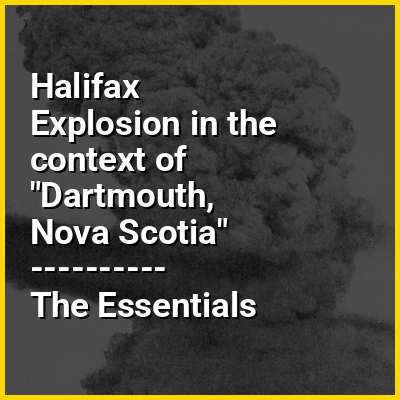
On the morning of 6 December 1917, the French cargo ship SS Mont-Blanc was hit by the Norwegian vessel SS Imo in the harbour of Halifax, Nova Scotia, Canada. Mont-Blanc, laden with high explosives, caught fire and detonated, devastating the Richmond district of Halifax. At least 1,782 people, largely in Halifax and Dartmouth, were killed by the blast, debris, fires, or collapsed buildings, and an estimated 9,000 others were injured. The blast was the largest human-made explosion at the time. It released the equivalent energy of roughly 2.9 kilotons of TNT (12 TJ).

Mont-Blanc was under orders from the French government to carry her cargo from New York City via Halifax to Bordeaux, France. At roughly 8:45 am, she collided at low speed, approximately one knot (1.2 mph or 1.9 km/h), with the unladen Imo, chartered by the Commission for Relief in Belgium to pick up a cargo of relief supplies in New York. On Mont-Blanc, the impact damaged benzol barrels stored on deck, causing them to leak vapours which were ignited by sparks from the collision, setting off a fire on board that quickly grew out of control. Approximately 20 minutes later at 9:04:35 am, Mont-Blanc exploded.
↓ Menu
HINT:

In this Dossier

Halifax Explosion in the context of Halifax Harbour

Halifax Harbour is a large natural harbour on the Atlantic coast of Nova Scotia, Canada, located in the Halifax Regional Municipality. Halifax largely owes its existence to the harbour, being one of the largest and deepest ice-free natural harbours in the world. Before Confederation it was one of the most important commercial ports on the Atlantic seaboard. In 1917, it was the site of the world's largest man-made accidental explosion, when the SS Mont-Blanc blew up in the Halifax Explosion on December 6.

The harbour was formed by a drowned glacial valley which succumbed to sea level rise after glaciation. The Sackville River now empties into the upper end of the harbour in Bedford Basin. The harbour also includes the Northwest Arm and The Narrows, a constricted passage to Bedford Basin.

View the full Wikipedia page for Halifax Harbour
↑ Return to Menu

Halifax Explosion in the context of SS Mont-Blanc

SS Mont-Blanc was a cargo steamship that was built in Middlesbrough, England, in 1899 for a French shipping company. On Thursday morning, December 6, 1917, she entered Halifax Harbour in Nova Scotia, Canada, laden with a full cargo of highly volatile explosives. As she made her way through the Narrows towards Bedford Basin, she was involved in a collision with Imo, a Norwegian ship. A fire aboard the ship ignited her wet and dry cargo - 2,300 tons of picric acid, 500 tons of TNT, and 10 tons of guncotton. The resultant Halifax Explosion killed about 2,000 people and injured about 9,000.

View the full Wikipedia page for SS Mont-Blanc
↑ Return to Menu