Haemophilia figured prominently in the history of European royalty in the 19th and 20th centuries. Queen Victoria and her husband, Prince Albert of the United Kingdom, through two of their five daughters – Princess Alice and Princess Beatrice – passed the mutation to various royal houses across the continent, including the royal families of Spain, Germany and Russia. Victoria's youngest son, Prince Leopold, Duke of Albany, also had the disease, though none of her three elder sons did. Tests on the remains of the Romanov imperial family show that the specific form of haemophilia passed down by Queen Victoria was probably the relatively rare haemophilia B. The presence of haemophilia B within the European royal families was well known, with the condition once popularly termed the 'royal disease.'
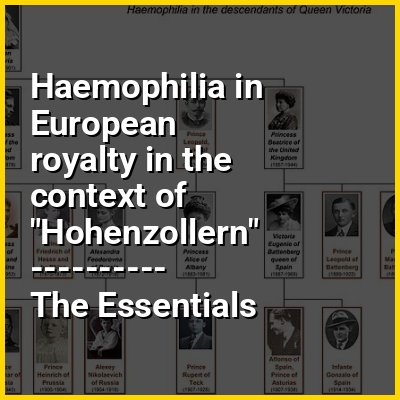
- ⭐ Core Definition: Haemophilia in European royalty
- Haemophilia in European royalty in the context of Alexandra Feodorovna (Alix of Hesse)
- Haemophilia in European royalty in the context of Family history (medicine)
Haemophilia in European royalty in the context of Alexandra Feodorovna (Alix of Hesse)
Alexandra Feodorovna (Russian: Александра Фёдоровна Романова, romanized: Aleksandra Fyodorovna Romanova; born Princess Alix of Hesse and by Rhine; 6 June 1872 – 17 July 1918) was the last empress of Russia as the consort of Nicholas II from their marriage on 26 November [O.S. 14 November] 1894 until his forced abdication on 15 March [O.S. 2 March] 1917. A granddaughter of Queen Victoria, Alexandra was one of the most famous royal carriers of hemophilia and passed the condition to her only son, Alexei.
Alexandra was deeply involved in the personal and political life of her husband, Tsar Nicholas II. Her reputation suffered due to her influence over Nicholas, particularly in her insistence on maintaining autocratic rule in the face of growing revolutionary pressures in Russia. Her relationship with the Russian mystic Grigori Rasputin became a subject of controversy. Rasputin's alleged ability to alleviate Alexei's suffering from hemophilia increased Alexandra's reliance on him, damaging the public perception of the Romanovs and fueling rumors about Rasputin's power within the royal family. These associations with Rasputin and her opposition to political reform were seen as contributing factors to the collapse of the Romanov dynasty.
View the full Wikipedia page for Alexandra Feodorovna (Alix of Hesse)Haemophilia in European royalty in the context of Family history (medicine)
In medicine, a family history (FH or FHx) consists of information about disorders of direct blood relatives of the patient. Genealogy typically includes very little of the medical history of the family, but the medical history could be considered a specific subset of the total history of a family. Accurate knowledge of a patient's family history may identify a predisposition to developing certain illnesses, which can inform clinical decisions and allow effective management or even prevention of conditions.
View the full Wikipedia page for Family history (medicine)