Greylag goose in the context of Domestic goose


Greylag goose in the context of Domestic goose

⭐ Core Definition: Greylag goose

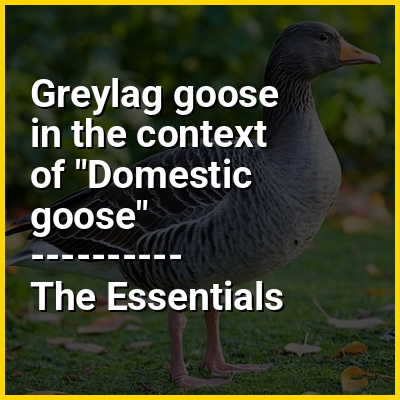
The greylag goose (Anser anser) is a species of large goose in the waterfowl family Anatidae and the type species of the genus Anser. It has mottled and barred grey and white plumage and an orange beak and pink legs. A large bird, it measures between 74 and 91 centimetres (29 and 36 in) in length, with an average weight of 3.3 kilograms (7 lb 4 oz). Its distribution is widespread, with birds from the north of its range in Europe and Asia often migrating southwards to spend the winter in warmer places, although many populations are resident, even in the north. It is the ancestor of most breeds of domestic goose, having been domesticated at least as early as 1360 BCE. The genus name and specific epithet are from anser, the Latin for "goose". In the USA, its name has been spelled "graylag".

Greylag geese travel to their northerly breeding grounds in spring, nesting on moorlands, in marshes, around lakes and on coastal islands. They normally mate for life and nest on the ground among vegetation. A clutch of three to five eggs is laid; the female incubates the eggs and both parents defend and rear the young. The birds stay together as a family group, migrating southwards in autumn as part of a flock, and separating the following year. During the winter they occupy semi-aquatic habitats, estuaries, marshes and flooded fields, feeding on grass and often consuming agricultural crops. Some populations, such as those in southern England and in urban areas across the species' range, are primarily resident and occupy the same area year-round.
↓ Menu
HINT:

In this Dossier

Greylag goose in the context of Konrad Lorenz

Konrad Zacharias Lorenz (Austrian German pronunciation: [ˈkɔnʁaːd tsaxaˈʁiːas ˈloːʁɛnts] ; 7 November 1903 – 27 February 1989) was an Austrian zoologist, ethologist, and ornithologist. He shared the 1973 Nobel Prize in Physiology or Medicine with Nikolaas Tinbergen and Karl von Frisch. He is often regarded as one of the founders of modern ethology, the study of animal behavior. He developed an approach that began with an earlier generation, including his teacher Oskar Heinroth.

Lorenz studied instinctive behavior in animals, especially in greylag geese and jackdaws. Working with geese, he investigated the principle of imprinting, the process by which some nidifugous birds (i.e. birds that leave their nest early) bond instinctively with the first moving object that they see within the first hours of hatching. Although Lorenz did not discover the topic, he became widely known for his descriptions of imprinting as an instinctive bond. In 1936, he met Tinbergen, and the two collaborated in developing ethology as a separate sub-discipline of biology. A Review of General Psychology survey, published in 2002, ranked Lorenz the 65th most cited scholar of the 20th century in the technical psychology journals, introductory psychology textbooks, and survey responses.

View the full Wikipedia page for Konrad Lorenz
↑ Return to Menu

Greylag goose in the context of Crop (anatomy)

The crop (also the croup, the craw, the ingluvies, and the sublingual pouch) is a thin-walled, expanded portion of the alimentary tract, which is used for the storage of food before digestion. The crop is an anatomical structure in vertebrate animals, such as birds, and invertebrate animals, such as gastropods (snails and slugs), earthworms, leeches, and insects.

View the full Wikipedia page for Crop (anatomy)
↑ Return to Menu