Greek Constitution of 1844 in the context of "Otto of Greece"

Play Trivia Questions online!

or

Skip to study material about Greek Constitution of 1844 in the context of "Otto of Greece"

Ad spacer

⭐ Core Definition: Greek Constitution of 1844

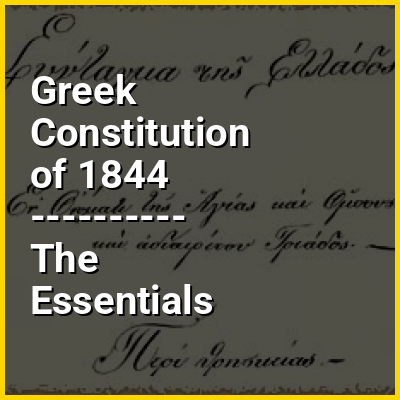
The first constitution of the Kingdom of Greece was the Greek Constitution of 1844. On 3 September 1843, the military garrison of Athens, with the help of citizens, rebelled and demanded from King Otto the concession of a Constitution.

The Constitution that was proclaimed in March 1844 came from the workings of the "Third of September National Assembly of the Hellenes in Athens" and was a Constitutional Pact, in other words a contract between the monarch and the Nation. This Constitution re-established the constitutional monarchy and was based on the French Constitution of 1830 and the Belgian Constitution of 1831.

↓ Menu

>>>PUT SHARE BUTTONS HERE<<<
In this Dossier

Greek Constitution of 1844 in the context of Kingdom of Greece (Glücksburg)

The Kingdom of Greece (Greek: Βασίλειον τῆς Ἑλλάδος, romanized: Vasíleion tis Elládos, pronounced [vaˈsili.on tis eˈlaðos]) was the Greek nation-state established in 1832 and was the successor state to the First Hellenic Republic. It was internationally recognised by the Treaty of Constantinople, where Greece also secured its full independence from the Ottoman Empire after nearly four centuries. It remained a Kingdom until 1924, when the Second Hellenic Republic was proclaimed, and from the Republic's collapse in 1935 to its dissolution by the Regime of the Colonels in 1973. A referendum following the regime's collapse in 1974 confirmed the effective dissolution of the monarchy and the creation of the Third Hellenic Republic. For much of its existence, the Kingdom's main ideological goal was the Megali Idea (Greek: Μεγάλη Ιδέα, romanized: Megáli Idéa, lit. 'Great Idea'), which sought to annex lands with predominately Greek populations.

King Otto of the House of Wittelsbach ruled as an absolute monarch from 1835 until the 3 September 1843 Revolution, which transformed Greece into a constitutional monarchy, with the creation of the Prime Minister as head of government, universal male suffrage and a constitution. A popular insurrection deposed Otto in 1862, precipitating the gradual collapse of the early Greek parties (English, French, Russian), which had dominated Greek politics.
↑ Return to Menu

Greek Constitution of 1844 in the context of 3 September 1843 Revolution

The 3 September 1843 Revolution (Greek: Επανάσταση της 3ης Σεπτεμβρίου 1843; N.S. 15 September) was an uprising by the Hellenic Army in Athens, supported by large sections of the people, against the autocratic rule of King Otto. The rebels, led by veterans of the Greek War of Independence, demanded the granting of a constitution and the departure of the Bavarian officials that dominated the government. The revolution succeeded, ushering the period of constitutional monarchy (under the 1844 constitution) and universal suffrage in Greece.

↑ Return to Menu

Greek Constitution of 1844 in the context of Syntagma Square

Syntagma Square (Greek: Πλατεία Συντάγματος, pronounced [plaˈtia sinˈdaɣmatos], "Constitution Square") is the central square of Athens, Greece. The square is named after the Constitution that Otto, the first King of Greece, was obliged to grant after a popular and military uprising on 3 September 1843. It is located in front of the 19th-century Old Royal Palace, housing the Greek Parliament since 1934. Syntagma Square is the most important square of modern Athens from both a historical and social point of view, at the heart of commercial activity and Greek politics. The name Syntagma (Greek: Σύνταγμα) alone also refers to the neighbourhood surrounding the square. The metro station underneath the square, where lines 2 and 3 connect, along with the tram terminal and the numerous bus stops, constitutes one of the busiest transport hubs in the country.

↑ Return to Menu