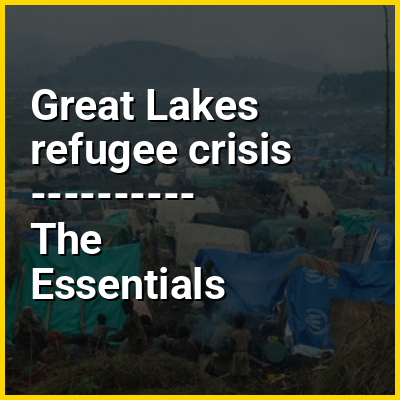
The Great Lakes refugee crisis is the common name for the situation beginning with the exodus in April 1994 of over two million Rwandans to neighboring countries of the Great Lakes region of Africa in the aftermath of the Rwandan genocide. Many of the refugees were Hutu fleeing the predominantly Tutsi Rwandan Patriotic Front (RPF), which had gained control of the country at the end of the genocide. However, the humanitarian relief effort was vastly compromised by the presence among the refugees of many of the Interahamwe and government officials who carried out the genocide, who used the refugee camps as bases to launch attacks against the new government led by Paul Kagame. The camps in Zaire became particularly politicized and militarized. The knowledge that humanitarian aid was being diverted to further the aims of the genocidaires led many humanitarian organizations to withdraw their assistance. The conflict escalated until the start of the First Congo War in 1996, when RPF-supported rebels invaded Zaire and sought to repatriate the refugees. The conflict escalated again with the start of the Second Congo War, also called Africa's World War or the Great War of Africa, that began in 1998 when the Congolese president Laurent-Désiré Kabila turned against his former allies from Rwanda and Uganda. The conflict continues with the Kivu conflict that started in 2004 with the start of the M23 rebellion that started in 2012.
>>>PUT SHARE BUTTONS HERE<<<
Great Lakes refugee crisis in the context of United Nations Assistance Mission for Rwanda
The United Nations Assistance Mission for Rwanda (UNAMIR) was established by United Nations Security Council Resolution 872 on 5 October 1993. It was intended to assist in the implementation of the Arusha Accords, signed on 4 August 1993, which was meant to end the Rwandan Civil War. The mission lasted from October 1993 to March 1996. Its activities were meant to aid the peace process between the Hutu-dominated Rwandese government and the Tutsi-dominated rebel Rwandan Patriotic Front (RPF). The UNAMIR has received much attention for its role in failing, due to the limitations of its rules of engagement, to prevent the Rwandan genocide and outbreak of fighting. Its mandate extended past the RPF overthrow of the government and into the Great Lakes refugee crisis. The mission is thus regarded as a major failure.