Gray's Inn in the context of "Adam Buddle"

Play Trivia Questions online!

or

Skip to study material about Gray's Inn in the context of "Adam Buddle"


⭐ Core Definition: Gray's Inn

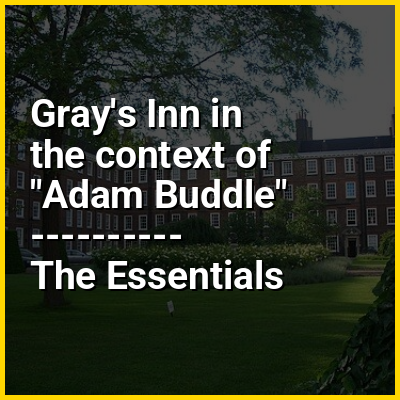
The Honourable Society of Gray's Inn, commonly known as Gray's Inn, is one of the four Inns of Court (professional associations for barristers and judges) in London. To be called to the bar in order to practise as a barrister in England and Wales, an individual must belong to one of these inns. Located at the intersection of High Holborn and Gray's Inn Road in Central London, the Inn is a professional body and provides office and some residential accommodation for barristers. It is ruled by a governing council called "Pension", made up of the Masters of the Bench (or "benchers") and led by the Treasurer, who is elected to serve a one-year term. The Inn is known for its gardens (the "Walks"), which have existed since at least 1597.

Gray's Inn does not claim a specific foundation date; none of the Inns of Court claims to be any older than the others. Law clerks and their apprentices have been established on the present site since at latest 1370, with records dating from 1381. During the 15th and 16th centuries, the Inn grew in size, peaking during the reign of Elizabeth I. The Inn was home to many important barristers and politicians, including Francis Bacon. Queen Elizabeth herself was a patron. As a result of the efforts of prominent members such as William Cecil and Gilbert Gerard, Gray's Inn became the largest of the four Inns by number, with over 200 barristers recorded as members. During this period, the Inn mounted masques and revels. William Shakespeare's The Comedy of Errors is believed first to have been performed in Gray's Inn Hall.
↓ Menu

👉 Gray's Inn in the context of Adam Buddle

Adam Buddle (1662 – 15 April 1715) was an English clergyman and botanist. Born at Deeping St James, a village near Peterborough, Buddle was educated at Woodbridge School and St Catharine's College, Cambridge, where he gained a BA in 1681, and a MA four years later. He was a Fellow from 1686 until 1691 when he was ejected as a non-juror but he later conformed.

Buddle was ordained as a deacon in 1685 and priest of the Church of England in December 1702, obtaining a living at North Fambridge, near Maldon, Essex, in 1703. He was also a reader at Gray's Inn under the patronage of Robert Moss. His life between graduation and ordination remains obscure, although it is known he lived in or around Hadleigh, Suffolk, that he established a reputation as an authority on bryophytes, and that he married Elizabeth Eveare in 1695, with whom he had several children. Buddle compiled a new English Flora, completed in 1708, but it was never published; the original manuscript and Buddle's herbarium were preserved as part of the Sloane collection at the Natural History Museum, London.

↓ Explore More Topics
In this Dossier

Gray's Inn in the context of Inner Temple

The Honourable Society of the Inner Temple, commonly known as the Inner Temple, is one of the four Inns of Court and is a professional association for barristers and judges. To be called to the Bar and practice as a barrister in England and Wales, a person must belong to one of these Inns. It is located in the wider Temple area, near the Royal Courts of Justice, and within the City of London. As a liberty, it functions largely as an independent local government authority.

The Inn is a professional body that provides legal training, selection, and regulation for members. It is ruled by a governing council called "Parliament", made up of the Masters of the Bench (or "Benchers"), and led by the Treasurer, who is elected to serve a one-year term. The Temple takes its name from the Knights Templar, who originally (until their abolition in 1312) leased the land to the Temple's inhabitants (Templars). The Inner Temple was a distinct society from at least 1388, although as with all the Inns of Court its precise date of founding is not known. After a disrupted early period (during which the Temple was almost entirely destroyed in the Peasants' Revolt) it flourished, becoming the second-largest Inn during the Elizabethan period (after Gray's Inn).

↑ Return to Menu

Gray's Inn in the context of B. R. Ambedkar

Bhimrao Ramji Ambedkar (Bhīmrāo Rāmjī Āmbēḍkar; 14 April 1891 – 6 December 1956) was an Indian jurist, economist, social reformer and political leader who chaired the committee that drafted the Constitution of India based on the debates of the Constituent Assembly of India and the first draft of Sir Benegal Narsing Rau. Ambedkar served as Law and Justice minister in the first cabinet of Jawaharlal Nehru. He later renounced Hinduism, converted to Buddhism and inspired the Dalit Buddhist movement.

After graduating from Elphinstone College, University of Bombay, Ambedkar studied economics at Columbia University and the London School of Economics, receiving doctorates in 1927 and 1923, respectively, and was among a handful of Indian students to have done so at either institution in the 1920s. During his time at the Columbia University, Ambedkar came under the influence of John Dewey and his philosophy of pragmatism. He also trained in the law at Gray's Inn, London. In his early career, he was an economist, professor, and lawyer. His later life was marked by his political activities; he became involved in campaigning and negotiations for partition, publishing journals, advocating political rights and social freedom for Dalits, and contributing to the establishment of the state of India. In 1956, he converted to Buddhism, initiating mass conversions of Dalits.

↑ Return to Menu

Gray's Inn in the context of Inns of Court

The Inns of Court in London are the professional associations for barristers in England and Wales. There are four Inns of Court: Gray's Inn, Lincoln's Inn, Inner Temple, and Middle Temple.

All barristers must belong to one of them. They have supervisory and disciplinary functions over their members. The Inns also provide libraries, dining facilities and professional accommodation. Each also has a church or chapel attached to it and is a self-contained precinct where barristers traditionally train and practise. However, growth in the legal profession, together with a desire to practise from more modern accommodations and buildings with lower rents, caused many barristers' chambers to move outside the precincts of the Inns of Court in the late 20th century.

↑ Return to Menu

Gray's Inn in the context of Bencher

A bencher or Master of the Bench is a senior member of an Inn of Court in England and Wales or the Inns of Court in Northern Ireland, or the Honorable Society of King's Inns in Ireland. Benchers hold office for life once elected. A bencher can be elected while still a barrister (usually, but not always, King's Counsel in the UK or Senior Counsel in Ireland), in recognition of the contribution that the barrister has made to the life of the Inn or to the law. Others become benchers as a matter of course when appointed as a High Court judge. The Inn may elect non-members as honorary benchers – for example, distinguished judges and lawyers from other countries, eminent non-lawyers or (in the English Inns) members of the British royal family, who become known as "Royal Benchers" once elected.

One member of each Inn is the Treasurer, a position which is held for one year only. While succession to the post of Treasurer was once dependent purely on seniority (or auncienty), this is no longer the case. The Treasurer is now elected. Two Readers are also elected each year.

↑ Return to Menu

Gray's Inn in the context of Gray's Inn Road

Gray's Inn Road (or Grays Inn Road) is an important road in Central London, located in the London Borough of Camden. The road begins at its junction with Holborn at the City of London boundary, passes north through the Holborn and King's Cross districts and terminates at King's Cross railway station. It is designated as part of the A5200 road.

As the home of the Honourable Society of Gray's Inn, one of England's four Inns of Court, Gray's Inn Road is known as a hub for law and legal professions in London. Gray's Inn Road is home to multiple scholarly institutes, including University College London's Eastman Dental Institute, a world-leading oral health institution, Westminster Kingsway College, and the City University of London's Inns of Court School of Law.

↑ Return to Menu

Gray's Inn in the context of Middle Temple

The Honourable Society of the Middle Temple, commonly known simply as Middle Temple, is one of the four Inns of Court entitled to call their members to the English Bar as barristers, the others being the Inner Temple (with which it shares Temple Church), Gray's Inn and Lincoln's Inn. It is located in the wider Temple area of London, near the Royal Courts of Justice, and within the City of London. As a liberty, it functions largely as an independent local government authority.

↑ Return to Menu

Gray's Inn in the context of Lincoln's Inn

The Honourable Society of Lincoln's Inn, commonly known as Lincoln's Inn, is one of the four Inns of Court (professional associations for barristers and judges) in London. To be called to the bar in order to practise as a barrister in England and Wales, an individual must belong to one of these inns. The other three are Middle Temple, Inner Temple, and Gray's Inn.

Lincoln's Inn is situated in Holborn, in the London Borough of Camden, just on the border with the City of London and the City of Westminster, and across the road from London School of Economics and Political Science, Royal Courts of Justice and King's College London's Maughan Library. The nearest tube station is Holborn tube station or Chancery Lane.

↑ Return to Menu

Gray's Inn in the context of Sampson Eure

Sir Sampson Eure (died 1659) was an English lawyer and politician who sat in the House of Commons at various times between 1621 and 1643. He supported the Royalist cause in the English Civil War.

Eure was the son of Sir Francis Eure of Upper Heyford, Oxfordshire, and his first wife, Elizabeth. He was admitted at Gray's Inn on 10 August 1610 and called to the bar in 1617.

↑ Return to Menu