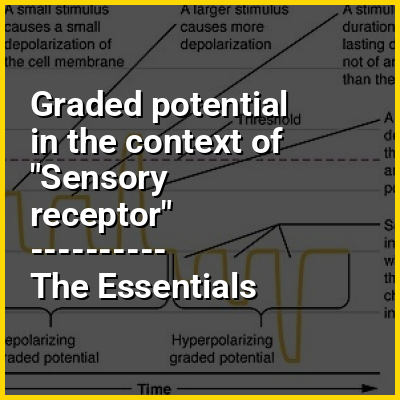
Graded potentials are changes in membrane potential that vary according to the size of the stimulus, as opposed to being all-or-none. They include diverse potentials such as receptor potentials, electrotonic potentials, subthreshold membrane potential oscillations, slow-wave potential, pacemaker potentials, and synaptic potentials. The magnitude of a graded potential is determined by the strength of the stimulus. They arise from the summation of the individual actions of ligand-gated ion channel proteins, and decrease over time and space. They do not typically involve voltage-gated sodium and potassium channels, but rather can be produced by neurotransmitters that are released at synapses which activate ligand-gated ion channels. They occur at the postsynaptic dendrite in response to presynaptic neuron firing and release of neurotransmitter, or may occur in skeletal, smooth, or cardiac muscle in response to nerve input. These impulses are incremental and may be excitatory or inhibitory.
>>>PUT SHARE BUTTONS HERE<<<
Graded potential in the context of Sensory neuron
Sensory neurons, also known as afferent neurons, are in the nervous system which convert a specific type of stimulus, via their receptors, into action potentials or graded receptor potentials. This process is called sensory transduction. The cell bodies of the sensory neurons are located in the dorsal root ganglia of the spinal cord.
The sensory information travels on the afferent nerve fibers in a sensory nerve, to the brain via the spinal cord. Spinal nerves transmit external sensations via sensory nerves to the brain through the spinal cord. The stimulus can come from exteroreceptors outside the body, or interoreceptors inside the body.
Graded potential in the context of Receptor potential
A receptor potential, also known as a generator potential, a type of graded potential, is the transmembrane potential difference produced by activation of a sensory receptor.
A receptor potential is often produced by sensory transduction. It is generally a depolarizing event resulting from inward current flow. The influx of current will often bring the membrane potential of the sensory receptor towards the threshold for triggering an action potential. Receptor potential can work to trigger an action potential either within the same neuron or on an adjacent cell. Within the same neuron, a receptor potential can cause local current to flow to a region capable of generating an action potential by opening voltage-gated ion channels. A receptor potential can also cause the release of neurotransmitters from one cell that will act on another cell, generating an action potential in the second cell. The magnitude of the receptor potential determines the frequency with which action potentials are generated and is controlled by adaptation, stimulus strength, and temporal summation of successive receptor potentials. Receptor potential relies on receptor sensitivity which can adapt slowly, resulting in a slowly decaying receptor potential or rapidly, resulting in a quickly generated but shorter-lasting receptor potential.