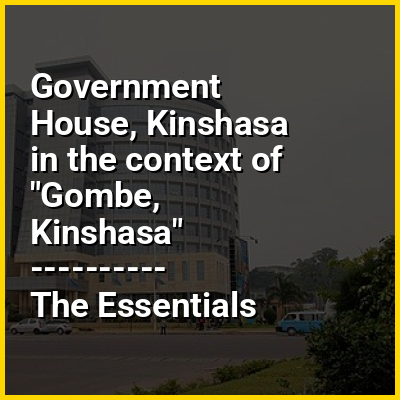
Kinshasa (; French: [kinʃasa]; Lingala: Kinsásá), formerly named Léopoldville from 1881–1966 (Dutch: Leopoldstad), is the capital and largest city of the Democratic Republic of the Congo. Kinshasa is one of the world's fastest-growing megacities, with an estimated population of 17.8 million in 2024. It is the most densely populated city in the DRC, the third-most populous city and third-largest metropolitan area in Africa, and the world's twenty-second most populous city and fourth-most populous capital city. It is the leading economic, political, and cultural center of the DRC, housing several industries including manufacturing, telecommunications, banking, and entertainment. The city also hosts some of the DRC's significant institutional buildings, such as the People's Palace, Palace of the Nation, Court of Cassation, Constitutional Court, African Union City, Marble Palace, Martyrs Stadium, Government House, Kinshasa Financial Center, and other national departments and agencies.
The Kinshasa site has been inhabited by Teke and Humbu people for centuries and was known as Nshasa before transforming into a commercial hub during the 19th and 20th centuries. The city was named Léopoldville by Henry Morton Stanley in honor of Leopold II of Belgium. The name was changed to Kinshasa in 1966 during Mobutu Sese Seko's Zairianisation campaign as a tribute to Nshasa village. Covering 9,965 square kilometers, Kinshasa stretches along the southern shores of the Pool Malebo on the Congo River. It forms an expansive crescent across flat, low-lying terrain at an average altitude of about 300 meters. Kinshasa borders the Mai-Ndombe Province, Kwilu Province, and Kwango Province to the east; the Congo River delineates its western and northern perimeters, constituting a natural border with the Republic of the Congo; to the south lies the Kongo Central Province. Across the river sits Brazzaville, the smaller capital of the neighboring Republic of the Congo, forming the world's closest pair of capital cities despite being separated by a four-kilometer-wide unbridged span of the Congo River.
View the full Wikipedia page for Kinshasa