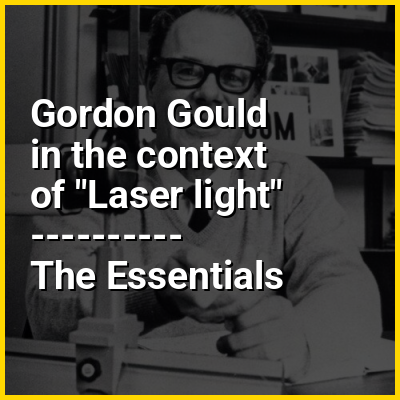
Richard Gordon Gould (July 17, 1920 – September 16, 2005) was an American physicist who is sometimes credited with the invention of the laser and the optical amplifier. (Credit for the invention of the laser is disputed, since Charles Townes and Arthur Schawlow were the first to publish the theory and Theodore Maiman was the first to build a working laser). Gould is best known for his thirty-year fight with the United States Patent and Trademark Office to obtain patents for the laser and related technologies. He also fought with laser manufacturers in court battles to enforce the patents he subsequently did obtain.
>>>PUT SHARE BUTTONS HERE<<<
In this Dossier
Gordon Gould in the context of Laser
A laser is a device that emits light through a process of optical amplification based on the stimulated emission of electromagnetic radiation. The word laser originated as an acronym for light amplification by stimulated emission of radiation. The first laser was built in 1960 by Theodore Maiman at Hughes Research Laboratories, based on theoretical work by Charles H. Townes and Arthur Leonard Schawlow and the optical amplifier patented by Gordon Gould.
A laser differs from other sources of light in that it emits light that is coherent. Spatial coherence allows a laser to be focused to a tight spot, enabling uses such as optical communication, laser cutting, and lithography. It also allows a laser beam to stay narrow over great distances (collimation), used in laser pointers, lidar, and free-space optical communication. Lasers can also have high temporal coherence, which permits them to emit light with a very narrow frequency spectrum. Temporal coherence can also be used to produce ultrashort pulses of light with a broad spectrum but durations measured in attoseconds.