Golden ratio in the context of "Straightedge and compass construction"

Play Trivia Questions online!

or

Skip to study material about Golden ratio in the context of "Straightedge and compass construction"


⭐ Core Definition: Golden ratio

In mathematics, two quantities are in the golden ratio if their ratio is the same as the ratio of their sum to the larger of the two quantities. Expressed algebraically, for quantities and with , is in a golden ratio to if where the Greek letter phi ( or ) denotes the golden ratio. The constant satisfies the quadratic equation and is an irrational number with a value of1.618033988749....The golden ratio was called the extreme and mean ratio by Euclid, and the divine proportion by Luca Pacioli; it also goes by other names.

Mathematicians have studied the golden ratio's properties since antiquity. It is the ratio of a regular pentagon's diagonal to its side and thus appears in the construction of the dodecahedron and icosahedron. A golden rectangle—that is, a rectangle with an aspect ratio of —may be cut into a square and a smaller rectangle with the same aspect ratio. The golden ratio has been used to analyze the proportions of natural objects and artificial systems such as financial markets, in some cases based on dubious fits to data. The golden ratio appears in some patterns in nature, including the spiral arrangement of leaves and other parts of vegetation.
↓ Menu

In this Dossier

Golden ratio in the context of Irrational number

In mathematics, the irrational numbers are all the real numbers that are not rational numbers. That is, irrational numbers cannot be expressed as the ratio of two integers. When the ratio of lengths of two line segments is an irrational number, the line segments are also described as being incommensurable, meaning that they share no "measure" in common, that is, there is no length ("the measure"), no matter how short, that could be used to express the lengths of both of the two given segments as integer multiples of itself.

Among irrational numbers are the ratio π of a circle's circumference to its diameter, Euler's number e, the golden ratio φ, and the square root of two. In fact, all square roots of natural numbers, other than of perfect squares, are irrational.

↑ Return to Menu

Golden ratio in the context of Algebraic number

In mathematics, an algebraic number is a number that is a root of a non-zero polynomial in one variable with integer (or, equivalently, rational) coefficients. For example, the golden ratio is an algebraic number, because it is a root of the polynomial , i.e., a solution to the equation , and the complex number is algebraic because it is a root of the polynomial . Algebraic numbers include all integers, rational numbers, and n-th roots of integers.

Algebraic complex numbers are closed under addition, subtraction, multiplication and division, and hence form a field, denoted . The set of algebraic real numbers is also a field.

↑ Return to Menu

Golden ratio in the context of Pitch angle of a spiral

In the geometry of spirals, the pitch angle or pitch of a spiral is the angle made by the spiral with a circle through one of its points, centered at the center of the spiral. Equivalently, it is the complementary angle to the angle made by the vector from the origin to a point on the spiral, with the tangent vector of the spiral at the same point. Pitch angles are used to characterize the steepness of spirals, such as in astronomy to describe spiral galaxies.

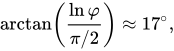
Logarithmic spirals, for example, are characterized by the property that the pitch angle remains invariant for all points of the spiral. Two logarithmic spirals are congruent when they have the same pitch angle, but otherwise are not congruent. For instance, only the golden spiral has pitch anglewhere denotes the golden ratio; logarithmic spirals with other angles are not golden spirals.

↑ Return to Menu

Golden ratio in the context of Rhombic triacontahedron

The rhombic triacontahedron, sometimes simply called the triacontahedron as it is the most common thirty-faced polyhedron, is a convex polyhedron with 30 rhombic faces. It has 60 edges and 32 vertices of two types. It is a Catalan solid, and the dual polyhedron of the icosidodecahedron. It is a zonohedron and can be seen as an elongated rhombic icosahedron.

The ratio of the long diagonal to the short diagonal of each face is exactly equal to the golden ratio, φ, so that the acute angles on each face measure 2 arctan(1/φ) = arctan(2), or approximately 63.43°. A rhombus so obtained is called a golden rhombus.

↑ Return to Menu

Golden ratio in the context of Mathematics and art

Mathematics and art are related in a variety of ways. Mathematics has itself been described as an art motivated by beauty. Mathematics can be discerned in arts such as music, dance, painting, architecture, sculpture, and textiles. This article focuses, however, on mathematics in the visual arts.

Mathematics and art have a long historical relationship. Artists have used mathematics since the 4th century BC when the Greek sculptor Polykleitos wrote his Canon, prescribing proportions conjectured to have been based on the ratio 1:2 for the ideal male nude. Persistent popular claims have been made for the use of the golden ratio in ancient art and architecture, without reliable evidence. In the Italian Renaissance, Luca Pacioli wrote the influential treatise De divina proportione (1509), illustrated with woodcuts by Leonardo da Vinci, on the use of the golden ratio in art. Another Italian painter, Piero della Francesca, developed Euclid's ideas on perspective in treatises such as De Prospectiva Pingendi, and in his paintings. The engraver Albrecht Dürer made many references to mathematics in his work Melencolia I. In modern times, the graphic artist M. C. Escher made intensive use of tessellation and hyperbolic geometry, with the help of the mathematician H. S. M. Coxeter, while the De Stijl movement led by Theo van Doesburg and Piet Mondrian explicitly embraced geometrical forms. Mathematics has inspired textile arts such as quilting, knitting, cross-stitch, crochet, embroidery, weaving, Turkish and other carpet-making, as well as kilim. In Islamic art, symmetries are evident in forms as varied as Persian girih and Moroccan zellige tilework, Mughal jali pierced stone screens, and widespread muqarnas vaulting.

↑ Return to Menu

Golden ratio in the context of Golden triangle (mathematics)

A golden triangle, also called a sublime triangle, is an isosceles triangle in which the duplicated side is in the golden ratio to the base side:

↑ Return to Menu