Glasgow Cathedral in the context of "Chapter house"

Play Trivia Questions online!

or

Skip to study material about Glasgow Cathedral in the context of "Chapter house"


⭐ Core Definition: Glasgow Cathedral

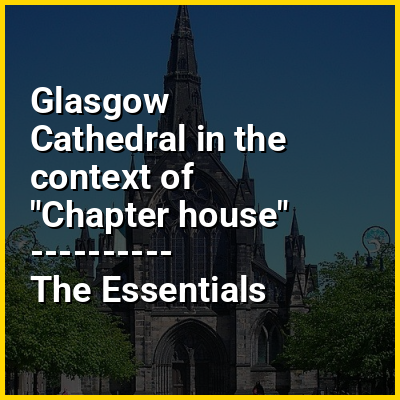
Glasgow Cathedral (Scottish Gaelic: Cathair-eaglais Ghlaschu) is a parish church of the Church of Scotland in Glasgow, Scotland. It was the cathedral church of the Archbishop of Glasgow, and the mother church of the Archdiocese of Glasgow and the province of Glasgow, from the 12th century until the Scottish Reformation in the 16th century. It is the oldest cathedral in mainland Scotland and the oldest building in Glasgow. With St Magnus Cathedral in Orkney, they are the only medieval cathedrals in Scotland to have survived the Reformation virtually intact. The medieval Bishop's Castle stood to the west of the cathedral until 1789. Although notionally it lies within the Townhead area of the city, the Cathedral grounds and the neighbouring Necropolis are considered to be their own district within the city.

The cathedral is dedicated to Saint Mungo (also known as Kentigern), the patron saint of Glasgow, whose tomb lies at the centre of the building's Lower Church. The first stone cathedral was dedicated in 1136, in the presence of David I. Fragments of this building have been found beneath the structure of the present cathedral, which was dedicated in 1197, although much of the present cathedral dates from a major rebuilding in the 13th century. Following its foundation in 1451, the University of Glasgow held its first classes within the cathedral's chapter house. After the Reformation, Glasgow Cathedral was internally partitioned to serve three separate congregations (Inner High, Outer High and Barony). The early 19th century saw a growing appreciation of the cathedral's medieval architecture, and by 1835 both the Outer High and Barony congregations had moved elsewhere in the city, allowing the restoration of the cathedral to something approaching its former glory.
↓ Menu

In this Dossier

Glasgow Cathedral in the context of Glasgow

Glasgow is the most populous city in Scotland, located on the banks of the River Clyde in west central Scotland. It is the fourth-most populous city in the United Kingdom and the 27th-most populous city in Europe, and comprises 23 wards which represent the areas of the city within Glasgow City Council. Glasgow is a leading city in Scotland for finance, shopping, industry, culture and fashion, and was commonly referred to as the "second city of the British Empire" for much of the Victorian and Edwardian eras.

In 2020, it had an estimated population as a defined locality of 632,350. More than 1,000,000 people live in the Greater Glasgow contiguous urban area, while the wider Glasgow City Region is home to more than 1,800,000 people (its defined functional urban area total was almost the same in 2020), around a third of Scotland's population. The city has a population density of 3,562 people per km, much higher than the average of 70/km for Scotland as a whole. Glasgow grew from a small rural settlement close to Glasgow Cathedral and descending to the River Clyde to become the largest seaport in Scotland, and the tenth-largest by tonnage in Britain. Expanding from the medieval bishopric and episcopal burgh (subsequently royal burgh), and the later establishment of the University of Glasgow in the 15th century, it became a major centre of the Scottish Enlightenment in the 18th century.

↑ Return to Menu

Glasgow Cathedral in the context of Townhead

Townhead (Scottish Gaelic: Ceann a' Bhaile, Scots: Tounheid) is a district within the city of Glasgow, Scotland. It is one of Glasgow's oldest areas, and contains two of its major surviving medieval landmarks – Glasgow Cathedral and the Provand's Lordship.

In medieval times, Townhead was the gateway into Glasgow from the north, while today it forms the north eastern extremity of the city centre. Townhead experienced great change between the mid 1950s and late 1970s following the publication of the infamous Bruce Report, when it was substantially depopulated and redeveloped. Today, it contains a much reduced resident population, a commercial/industrial sector and an educational quarter centred around the campuses of both the University of Strathclyde and City of Glasgow College.

↑ Return to Menu

Glasgow Cathedral in the context of St Mary's Cathedral, Glasgow

The Cathedral Church of St Mary the Virgin, commonly called St Mary's Cathedral, is a cathedral of the Scottish Episcopal Church. It is located on the Great Western Road, in the west end of Glasgow, Scotland. The current building was opened on 9 November 1871 as St Mary's Episcopal Church and was completed in 1893 when the spire was completed. The architect was Sir Gilbert Scott. It was raised to cathedral status in 1908. The total height of the cathedral is 63 metres. The church structure is protected as a category A listed building.

The other cathedrals in Glasgow are St Andrew's (Roman Catholic), St Luke's (Eastern Orthodox) and St Mungo's, the city's mediaeval cathedral, now used by the Church of Scotland, which has a presbyterian polity and does not use the term ‘cathedral’ to describe its churches.

↑ Return to Menu