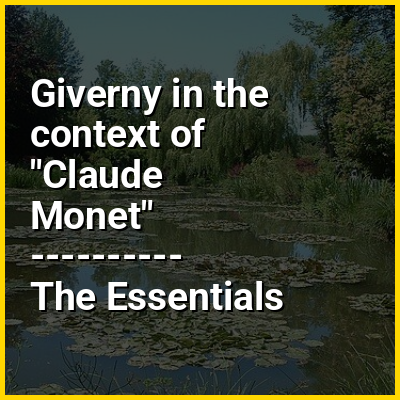
Giverny (French:[ʒivɛʁni]) is a commune in the northern French department of Eure. The village is located on the "right bank" of the river Seine at its confluence with the river Epte. It lies 80 km (50 mi) west-northwest of Paris, in the region of Normandy. It is best known as the location of Claude Monet's garden and home.
Several American Impressionist artists also settled in Giverny, drawn by the landscapes, the overall atmosphere, and the presence of Monet. Other attractions include the Museum of Impressionism Giverny, dedicated to the history of impressionism and the Giverny art colony, and the Hôtel Baudy, which was the center of artistic life in Giverny's heyday. It is now a café and restaurant, with period decoration.
Oscar-Claude Monet (UK: /ˈmɒneɪ/, US: /moʊˈneɪ,məˈ-/; French:[klodmɔnɛ]; 14 November 1840 – 5 December 1926) was a French painter and founder of Impressionism who is seen as a key precursor to modernism, especially in his attempts to paint nature as he perceived it. During his long career, he was the most consistent and prolific practitioner of Impressionism's philosophy of expressing one's perceptions of nature, especially as applied to plein air (outdoor) landscape painting. The term "Impressionism" is derived from the title of his painting Impression, Sunrise (Impression, soleil levant), which was exhibited in 1874 at the First Impressionist Exhibition, initiated by Monet and a number of like-minded artists as an alternative to the Salon.
Monet was raised in Le Havre, Normandy, and became interested in the outdoors and drawing from an early age. Although his mother, Louise-Justine Aubrée Monet, supported his ambitions to be a painter, his father, Claude-Adolphe, disapproved and wanted him to pursue a career in business. He was very close to his mother, but she died in January 1857 when he was sixteen years old, and he was sent to live with his childless, widowed but wealthy aunt, Marie-Jeanne Lecadre. He went on to study at the Académie Suisse, and under the academic history painterCharles Gleyre, where he was a classmate of Auguste Renoir. His early works include landscapes, seascapes, and portraits, but attracted little attention. A key early influence was Eugène Boudin, who introduced him to the concept of plein air painting. From 1883, Monet lived in Giverny, also in northern France, where he purchased a house and property and began a vast landscaping project, including a water-lily pond.
Water Lilies (French: Nymphéas[nɛ̃.fe.a]) is a series of approximately 250 oil paintings by French ImpressionistClaude Monet (1840–1926). The paintings depict his flower garden at his home in Giverny, and were the main focus of his artistic production during the last 31 years of his life. Many of the works were painted while Monet suffered from cataracts.
Claude Monet lived at Giverny near the river for more than forty years. In his garden, by diverting a branch of the Epte, he established a water garden with a water-lily pond and Japanese-style bridge. The river appears in a number of his works, including Peupliers au bord de l'Epte.
Giverny in the context of Fondation Monet in Giverny
The Fondation Claude Monet is a nonprofit that manages the house and gardens of Claude Monet in Giverny, France, where Monet lived and painted for 43 years. Monet was inspired by his gardens, and spent years transforming them, planting thousands of flowers. He believed that it was important to surround himself with nature and paint outdoors. He created many paintings of his house and gardens, especially of water lilies in the pond, the Japanese bridge, and a weeping willow tree.
With a total of 530,000 visitors in 2010, it is the second most visited tourist site in Normandy after the island of Mont Saint-Michel. The house and gardens have been listed among the Maisons des Illustres and classified as a Jardin Remarquable. The estate was classified as a monument historique in 1976.