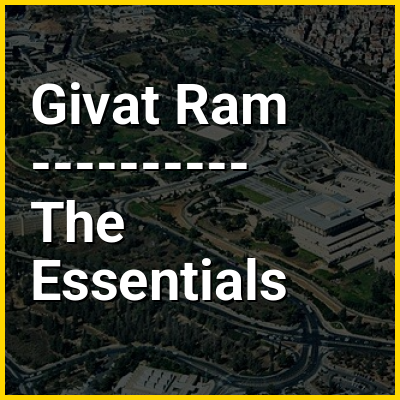
Givat Ram (Hebrew: גִּבְעַת רָם) is a neighborhood in central Jerusalem. It is the site of Kiryat HaMemshala (Hebrew: קריית הממשלה, lit. Government complex), which includes many of Israel's most important national institutions, among them the Knesset (Israel's parliament), the Israel Museum (as well as the private Bible Lands Museum), the Supreme Court, Bank of Israel, Academy of the Hebrew Language, National Library, one of the campuses of the Hebrew University of Jerusalem, and many government ministries' offices.
HINT:
In this Dossier
- ⭐ Core Definition: Givat Ram
- Givat Ram in the context of Israel Museum
- Givat Ram in the context of Israeli parliament
- Givat Ram in the context of Israeli Supreme Court
- Givat Ram in the context of Hebrew University of Jerusalem
- Givat Ram in the context of Shrine of the Book
- Givat Ram in the context of Supreme Court of Israel
- Givat Ram in the context of Kiryat HaMemshala
Givat Ram in the context of Israel Museum
The Israel Museum (Hebrew: מוזיאון ישראל, romanized: Muze'on Yisrael, Arabic: متحف إسرائيل) is an art and archaeology museum in Jerusalem. It was established in 1965 as Israel's largest and foremost cultural institution, and an encyclopedic museum. It is situated on a hill in the Givat Ram neighborhood of Jerusalem, adjacent to the Bible Lands Museum, the National Campus for the Archaeology of Israel, the Knesset, the Israeli Supreme Court, and the Hebrew University of Jerusalem.
The Israel Museum houses a collection of approximately 500,000 items. Its holdings include the world's most comprehensive collections of the archaeology of the Holy Land, and Jewish art and life, as well as significant and extensive holdings in the fine arts, the latter encompassing eleven separate departments: Israeli Art, European Art, Modern Art, Contemporary Art, Prints and Drawings, Photography, Design and Architecture, Asian Art, African Art, Oceanian Art, and Arts of the Americas.
View the full Wikipedia page for Israel MuseumGivat Ram in the context of Israeli parliament
The Knesset (Hebrew: הַכְּנֶסֶת, romanized: HaKnesset [haˈkneset] lit. 'gathering, assembly', Arabic: الْكِنِيسِت, romanized: al-Kinisit) is the unicameral legislature of Israel.
The Knesset passes all laws, elects the president and prime minister, approves the cabinet, and supervises the work of the government, among other things. In addition, the Knesset elects the state comptroller. It also has the power to waive the immunity of its members, remove the president and the state comptroller from office, dissolve the government in a constructive vote of no confidence, and to dissolve itself and call new elections. The prime minister may also dissolve the Knesset. However, until an election is completed, the Knesset maintains authority in its current composition. The Knesset meets in its building in Givat Ram, Jerusalem.
View the full Wikipedia page for Israeli parliamentGivat Ram in the context of Israeli Supreme Court
The Supreme Court of Israel (Hebrew: בֵּית הַמִּשְׁפָּט הָעֶלְיוֹן, romanized: Be(i)t HaMishpat HaElyon, Hebrew acronym Bagatz; Arabic: المحكمة العليا, romanized: al-Maḥkama al-‘Ulyā) is the highest court in Israel. It has ultimate appellate jurisdiction over all other courts, and in some cases original jurisdiction.
The Supreme Court consists of 15 judges appointed by the President of Israel, upon nomination by the Judicial Selection Committee. Once appointed, Judges serve until retirement at the age of 70 unless they resign or are removed from office. The Court is situated in Jerusalem's Givat Ram governmental campus, about half a kilometer from Israel's legislature, the Knesset. By the principle of binding precedent (stare decisis), Supreme Court rulings are binding upon every other court, except itself. Over the years, it has ruled on numerous sensitive issues, some of which relate to the Israeli–Palestinian conflict, the rights of Arab citizens, and discrimination between Jewish groups in Israel.
View the full Wikipedia page for Israeli Supreme CourtGivat Ram in the context of Hebrew University of Jerusalem
The Hebrew University of Jerusalem (HUJI; Hebrew: הַאוּנִיבֶרְסִיטָה הַעִבְרִית בִּירוּשָׁלַיִם) is an Israeli public research university based in Jerusalem. Co-founded by Albert Einstein and Chaim Weizmann in July 1918, it is the second-oldest institution of higher learning in Israel, having been founded 30 years before the establishment of the State of Israel but six years after the older Technion university.
The university has five affiliated teaching hospitals (including the Hadassah Medical Center), seven faculties, more than 100 research centers, and 315 academic departments. As of 2018, one-third of all the doctoral candidates in Israel were studying at the HUJI. The HUJI has three campuses in Jerusalem: one in Rehovot, one in Rishon LeZion and one in Eilat. Until 2023, the world's largest library for Jewish studies—the National Library of Israel—was located on its Edmond J. Safra campus in the Givat Ram neighbourhood of Jerusalem.
View the full Wikipedia page for Hebrew University of JerusalemGivat Ram in the context of Shrine of the Book
The Shrine of the Book (Hebrew: היכל הספר, Heikhal HaSefer) is a wing of the Israel Museum in the Givat Ram neighborhood of Jerusalem that houses the Dead Sea Scrolls and the Aleppo Codex, among others.
View the full Wikipedia page for Shrine of the BookGivat Ram in the context of Supreme Court of Israel
The Supreme Court of Israel (Hebrew: בֵּית הַמִּשְׁפָּט הָעֶלְיוֹן, romanized: Be(i)t HaMishpat HaElyon, Hebrew acronym Bagatz; Arabic: المحكمة العليا, romanized: al-Maḥkama al-‘Ulyā) is the highest court in Israel. It has ultimate appellate jurisdiction over all other courts, and in some cases original jurisdiction.
The Supreme Court consists of 15 judges appointed by the president of Israel, upon nomination by the Judicial Selection Committee. Once appointed, Judges serve until retirement at the age of 70 unless they resign or are removed from office. The Court is situated in Jerusalem's Givat Ram governmental campus, about half a kilometer from Israel's legislature, the Knesset. By the principle of binding precedent (stare decisis), Supreme Court rulings are binding upon every other court, except itself. Over the years, it has ruled on numerous sensitive issues, some of which relate to the Israeli–Palestinian conflict, the rights of Arab citizens, and discrimination between Jewish groups in Israel.
View the full Wikipedia page for Supreme Court of IsraelGivat Ram in the context of Kiryat HaMemshala
Kiryat HaMemshala (Hebrew: קרית הממשלה, lit. 'Government complex'), also known as Kiryat Ben-Gurion (Hebrew: קריית בן-גוריון, lit. 'Ben-Gurion complex'), is the government precinct of the State of Israel. It is located in the Givat Ram neighborhood of Jerusalem.
View the full Wikipedia page for Kiryat HaMemshala