Giovanni Gentile in the context of "Italian philosophy"

Play Trivia Questions online!

or

Skip to study material about Giovanni Gentile in the context of "Italian philosophy"


⭐ Core Definition: Giovanni Gentile

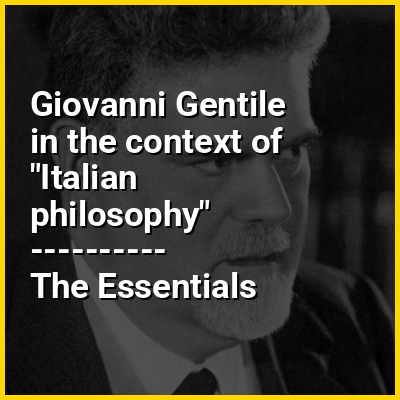
Giovanni Gentile (/ɛnˈtl/ jen-TEE-lay; Italian: [dʒoˈvanni dʒenˈtiːle]; 30 May 1875 – 15 April 1944) was an Italian pedagogue, philosopher, and politician.

He, alongside Benedetto Croce, was one of the major exponents of Italian idealism in Italian philosophy, and also devised his own system of thought, which he called "actual idealism" or "actualism", which has been described as "the subjective extreme of the idealist tradition".
↓ Menu

In this Dossier

Giovanni Gentile in the context of Italian fascism

Italian fascism (Italian: fascismo italiano), also called classical fascism and fascism, is the original fascist ideology, which Giovanni Gentile and Benito Mussolini developed in Italy. The ideology of Italian fascism is associated with a series of political parties led by Mussolini: the National Fascist Party (PNF), which governed the Kingdom of Italy from 1922 until 1943, and the Republican Fascist Party (PFR), which governed the Italian Social Republic from 1943 to 1945. Italian fascism also is associated with the post–war Italian Social Movement (MSI) and later Italian neo-fascist political organisations.

Italian fascism originated from ideological combinations of ultranationalism and Italian nationalism, national syndicalism and revolutionary nationalism, and from the militarism of Italian irredentism to regain "lost overseas territories of Italy" deemed necessary to restore Italian nationalist pride. Italian Fascists also claimed that modern Italy was an heiress to the imperial legacy of Ancient Rome, and that there existed historical proof which supported the creation of an Imperial Fascist Italy to provide spazio vitale (vital space) for the Second Italo-Senussi War of Italian settler colonisation en route to establishing hegemonic control of the terrestrial basin of the Mediterranean Sea.

↑ Return to Menu

Giovanni Gentile in the context of Absolute idealist

Absolute idealism is chiefly associated with Friedrich Schelling and G. W. F. Hegel, both of whom were German idealist philosophers in the 19th century. The label has also been attached to others such as Josiah Royce, an American philosopher who was greatly influenced by Hegel's work, the British idealists (often referred to as neo-Hegelian), and the italian idealists, particularly the actual idealism of Giovanni Gentile.

According to Hegel, being is ultimately comprehensible only as an all-inclusive whole (das Absolute). Hegel asserted that in order for the thinking subject (human reason or consciousness) to be able to know its object (the world) at all, there must be in some sense an identity of thought and being. Otherwise, the subject would never have access to the object and we would have no certainty about any of our knowledge of the world.

↑ Return to Menu

Giovanni Gentile in the context of Benedetto Croce

Benedetto Croce, OCI, COSML (/ˈkr/ KROH-chay; Italian: [beneˈdetto ˈkroːtʃe]; 25 February 1866 – 20 November 1952)was an Italian idealist philosopher, historian, and politician who wrote on numerous topics, including philosophy, history, historiography, and aesthetics. A political liberal in most regards, he formulated a distinction between liberalism (as support for civil liberties) and "liberism" (as support for laissez-faire economics and capitalism). Croce had considerable influence on other Italian intellectuals, from Marxists to Italian fascists, such as Antonio Gramsci and Giovanni Gentile, respectively.

He had a long career in the Italian Parliament, joining the Senate of the Kingdom of Italy in 1910, serving through Fascism and the Second World War before being elected to the Constituent Assembly as a Liberal. In the 1948 general election he was elected to the new republican Senate and served there until his death. He was a longtime member of the Italian Liberal Party, serving as its president from 1944 to 1947.

↑ Return to Menu

Giovanni Gentile in the context of Italian idealism

Italian idealism, born from interest in the German movement and particularly in Hegelian doctrine, developed in Italy starting from the spiritualism of the nineteenth-century Risorgimento tradition, and culminated in the first half of the twentieth century in its two greatest exponents: Benedetto Croce and Giovanni Gentile.

↑ Return to Menu

Giovanni Gentile in the context of Actual idealism

Actual idealism is a form of idealism, developed by Giovanni Gentile, that was influenced by the absolute idealism of G. W. F. Hegel.

↑ Return to Menu