German occupation of Belgium during World War II in the context of Royal Palace of Brussels


German occupation of Belgium during World War II in the context of Royal Palace of Brussels

⭐ Core Definition: German occupation of Belgium during World War II

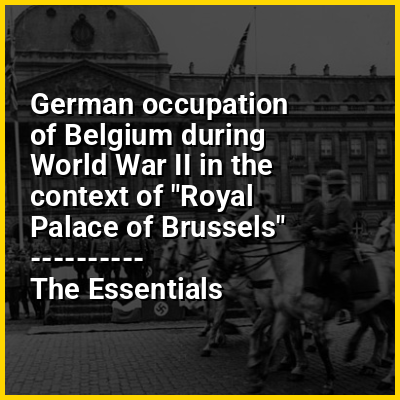
The German occupation of Belgium (French: Occupation allemande, Dutch: Duitse bezetting) during World War II began on 28 May 1940, when the Belgian army surrendered to German forces, and lasted until Belgium's liberation by the Western Allies between September 1944 and February 1945. It was the second time in less than thirty years that Germany had occupied Belgium.

After the success of the invasion, a military administration was established in Belgium, bringing the territory under the direct rule of the Wehrmacht. Thousands of Belgian soldiers were taken as prisoners of war, and many were not released until 1945. The German administration juggled competing objectives of maintaining order while extracting material from the territory for the war effort. They were assisted by the Belgian civil service, which believed that limited co-operation with the occupiers would result in the least damage to Belgian interests. Belgian Fascist parties in both Flanders and Wallonia, established before the war, collaborated much more actively with the occupiers: they helped recruit Belgians for the German army and were given more power themselves toward the end of the occupation. Food and fuel were tightly rationed, and all official news was closely censored. Belgian civilians living near possible targets such as railway junctions were in danger of Allied aerial bombing.
↓ Menu
HINT:

In this Dossier

German occupation of Belgium during World War II in the context of Flemish separatism

The Flemish Movement (Dutch: Vlaamse Beweging, pronounced [ˈvlaːmsə bəˈʋeːɣɪŋ]) is an umbrella term which encompasses various political groups in the Belgian region of Flanders and, less commonly, in French Flanders. Ideologically, it encompasses groups which have sought to promote Flemish culture and the Dutch language as well as those seeking greater political autonomy for Flanders within Belgium. It also encompasses nationalists who seek the secession of Flanders from Belgium, either through outright independence or unification with the Netherlands.

In the 19th century, the Flemish Movement emerged around a form of cultural patriotism which celebrated the regional traditions and history of Flanders and sought equal status for Dutch in the Belgian nation-state, often under the auspices of the Catholic Church. Although gaining a number of its initial objectives, it became increasingly radical in the aftermath of World War I. Inspired by authoritarian and fascist politics, it was widely discredited for its association with collaboration in German-occupied Belgium during World War II. However, it re-emerged in the post-war period under the auspices of the Volksunie (1954–2002) and increasingly permeated into other parties in Flanders. It played an important role in Belgium's transformation into a federal state through the 1970s and 1980s.

View the full Wikipedia page for Flemish separatism
↑ Return to Menu

German occupation of Belgium during World War II in the context of Sequestration (law)

In law, sequestration is the act of removing, separating, or seizing anything from the possession of its owner under process of law for the benefit of creditors or the state.

View the full Wikipedia page for Sequestration (law)
↑ Return to Menu

German occupation of Belgium during World War II in the context of Hergé

Georges Prosper Remi (French: [ʒɔʁʒ pʁɔspɛʁ ʁəmi]; 22 May 1907 – 3 March 1983), known by the pen name Hergé (/ɛərˈʒ/ air-ZHAY; French: [ɛʁʒe] ), from the French pronunciation of his reversed initials RG, was a Belgian comic strip artist. He is best known for creating The Adventures of Tintin, the series of comic albums that are considered one of the most popular European comics of the 20th century. He was also responsible for two other well-known series, Quick & Flupke (1930–1940) and The Adventures of Jo, Zette and Jocko (1936–1957). His works were executed in his distinctive ligne claire drawing style.

Born to a lower-middle-class family in Etterbeek, Brussels, Hergé began his career by contributing illustrations to Scouting magazines, developing his first comic series, The Adventures of Totor, for Le Boy-Scout Belge in 1926. Working for the conservative Catholic newspaper Le Vingtième Siècle, he created The Adventures of Tintin in 1929 on the advice of its editor Norbert Wallez. Revolving around the actions of boy reporter Tintin and his dog Snowy, the series' early instalments – Tintin in the Land of the Soviets, Tintin in the Congo, and Tintin in America – were designed as conservative propaganda for children. Domestically successful, after serialisation the stories were published in book form, with Hergé continuing the series and also developing both the Quick & Flupke and Jo, Zette and Jocko series for Le Vingtième Siècle. Influenced by his friend Zhang Chongren, from 1934 Hergé placed far greater emphasis on conducting background research for his stories, resulting in increased realism from The Blue Lotus onward. Following the German occupation of Belgium in 1940, Le Vingtième Siècle was closed, but Hergé continued his series in Le Soir, a popular newspaper controlled by the Nazi administration.

View the full Wikipedia page for Hergé
↑ Return to Menu

German occupation of Belgium during World War II in the context of Raversijde

Raversijde (West Flemish: Raversyde) is a neighborhood and former parish of the West Flemish town of Ostend. It is adjacent to Middelkerke, another neighborhood, which is located on the North Sea coast. Raversijde is located on the Kusttram, which is the coastal tramway.

Raversijde has the remains of the Atlantic Wall in the dunes built under the German Occupation of Belgium in the Second World War. It is also the site of the Atlantic Wall Open Air Museum where the remains of the Atlantic Wall built under the German Occupation of Belgium in the Second World War are preserved and open to visitors.

View the full Wikipedia page for Raversijde
↑ Return to Menu

German occupation of Belgium during World War II in the context of The Holocaust in Belgium

The Holocaust saw the systematic dispossession, deportation, and murder of Jews and Roma in German-occupied Belgium during World War II. Out of about 66,000 Jews in the country in May 1940, around 28,000 were murdered during the Holocaust.

At the start of the war, the population of Belgium was overwhelmingly Catholic. Jews made up the largest non-Christian population in the country, numbering between 70–75,000 out of a population of 8 million. Most lived in the cities of Antwerp, Brussels, Charleroi and Liège. The vast majority were recent immigrants to Belgium who had fled persecution in Germany and Eastern Europe, and, as a result, only a small minority actually possessed Belgian citizenship.

View the full Wikipedia page for The Holocaust in Belgium
↑ Return to Menu

German occupation of Belgium during World War II in the context of Paul de Man

Paul de Man (/dəˈmɑːn/; Dutch: [də mɑn]; December 6, 1919 – December 21, 1983), born Paul Adolph Michel Deman, was a Belgian-born American literary critic and literary theorist. He was known particularly for his importation of German and French philosophical approaches into Anglo-American literary studies and critical theory. Along with Jacques Derrida, he was part of an influential critical movement that went beyond traditional interpretation of literary texts to reflect on the epistemological difficulties inherent in any textual, literary, or critical activity. This approach aroused considerable opposition, which de Man attributed to "resistance" inherent in the difficult enterprise of literary interpretation itself.

After his death, de Man became a subject of further controversy when his history of writing pro-Nazi and anti-Jewish propaganda for the wartime edition of Le Soir, a major Belgian newspaper during German occupation, came to light.

View the full Wikipedia page for Paul de Man
↑ Return to Menu

German occupation of Belgium during World War II in the context of Belgian Resistance

The Belgian Resistance (French: Résistance belge, Dutch: Belgisch verzet) collectively refers to the resistance movements opposed to the German occupation of Belgium during World War II. Within Belgium, resistance was fragmented between many separate organizations, divided by region and political stances. The resistance included both men and women from both Walloon and Flemish parts of the country. Aside from sabotage of military infrastructure in the country and assassinations of collaborators, these groups also published large numbers of underground newspapers, gathered intelligence and maintained various escape networks that helped Allied airmen trapped behind enemy lines escape from German-occupied Europe.

During the war, it is estimated that approximately five percent of the national population were involved in some form of resistance activity, while some estimates put the number of resistance members killed at over 19,000; roughly 25 percent of its "active" members.

View the full Wikipedia page for Belgian Resistance
↑ Return to Menu

German occupation of Belgium during World War II in the context of Legislative Order (Belgium)

Legislative Order (Dutch: Wet-besluit or Besluitwet, French: Arrêté-loi, literally translated in English as law-order) in Belgium refers to laws adopted by the Belgian Government during the First and the Second World War, when the Belgian Parliament was unable to meet.

View the full Wikipedia page for Legislative Order (Belgium)
↑ Return to Menu

German occupation of Belgium during World War II in the context of Atlantic pockets

In World War II, the Atlantic pockets were locations along the coasts of the Netherlands, Belgium and France chosen as strongholds by the occupying German forces, to be defended as long as possible against land attack by the Allies.

The locations are known in German as Atlantikfestungen (lit. "Atlantic strongholds") but are known in English as "Atlantic pockets".

View the full Wikipedia page for Atlantic pockets
↑ Return to Menu