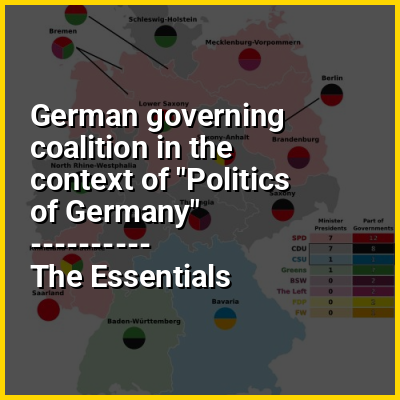
In Germany's federal electoral system, a single party or parliamentary group rarely wins an absolute majority of seats in the Bundestag, and thus coalition governments, rather than single-party governments, are the usually expected outcome of a German election. As German political parties are often associated with particular colors, coalitions are frequently given nicknames based on the colors included. Prominent political parties in Germany are the CDU/CSU (black), the SPD (red), the Greens (green), the Left (red, or alternatively magenta to distinguish from the SPD), the AfD (blue), and the FDP (yellow).
>>>PUT SHARE BUTTONS HERE<<<
In this Dossier
German governing coalition in the context of List of political parties in Germany
The Federal Republic of Germany has a plural multi-party system. Historically, the largest by members and parliament seats are the Christian Democratic Union (CDU), with its sister party, the Christian Social Union (CSU) and Social Democratic Party of Germany (SPD). Germany also has a number of other parties, in recent history most importantly the Free Democratic Party (FDP), Alliance 90/The Greens, The Left, and more recently the Alternative for Germany (AfD). The federal government of Germany often consisted of a coalition of a major and a minor party, specifically CDU/CSU and FDP or SPD and FDP, and from 1998 to 2005 SPD and Greens. From 1966 to 1969, from 2005 to 2009, from 2013 to 2021 and since 2025, the federal government consisted of a coalition of the two major parties, called a grand coalition.
Coalitions in the Bundestag and state legislatures are often described by party colors. Party colors are red for the Social Democratic Party, green for Alliance 90/The Greens, yellow for the Free Democratic Party, purple (officially red, which is customarily used for the SPD) for the Left, light blue for the AfD, and black and blue for the CDU and CSU respectively.
German governing coalition in the context of Grand coalition (Germany)
In German politics, a grand coalition (German: Große Koalition [ˈɡʁoːsə koaliˈt͡si̯oːn] , shortened to: German: Groko [ˈɡʁoːkoː] ) is a governing coalition between the two parties with the most parliamentarians on federal or state level. The term is generally linked to a coalition between the centre-right CDU/CSU alliance (Union, consisting of the Christian Democratic Union (CDU) and Christian Social Union of Bavaria (CSU) parties) and the centre-left Social Democratic Party (SPD), since they have historically been the major parties in most state and federal elections since 1949. The meaning of the term changed due to the growth of some formerly minor parties in recent years. It is the current governing coalition of Germany under the Merz cabinet following the 2025 federal election, and marks the first time that one of the two parties does not have the most or second most seats in the Bundestag (the AfD won the second most seats). Therefore, the latest coalition between CDU/CSU and SPD is often instead described as a black-red coalition, referring to the respective colors of the two blocs. If the coalition also includes the liberal Free Democratic Party (FDP), it is called a "Germany coalition" (German: Deutschland-Koalition (de)), with the party colors matching the flag of Germany: black for CDU/CSU, red for SPD and yellow for FDP.