George Julius Poulett Scrope in the context of Stroud, Gloucestershire


George Julius Poulett Scrope in the context of Stroud, Gloucestershire

⭐ Core Definition: George Julius Poulett Scrope

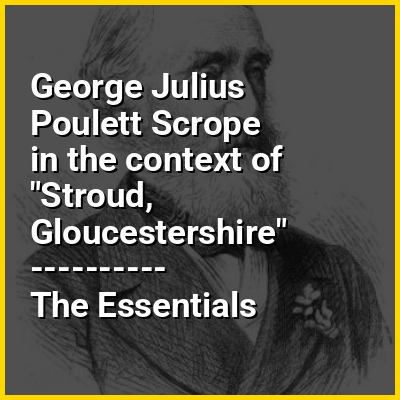
George Julius Poulett Scrope FRS (10 March 1797 – 19 January 1876) was an English geologist and political economist as well as a Member of Parliament and magistrate for Stroud in Gloucestershire.

While an undergraduate at Cambridge, through the influence of Edward Clarke and Adam Sedgwick he became interested in mineralogy and geology. During the winter of 1816–1817 he was at Naples, and was so keenly interested in Vesuvius that he renewed his studies of the volcano in 1818; and in the following year visited Etna and the Lipari Islands. In 1821 he married the daughter and heiress of William Scrope of Castle Combe, Wiltshire, and assumed her name; and he entered the House of Commons of the United Kingdom in 1833 as MP for Stroud, retaining his seat until 1868.
↓ Menu
HINT:

In this Dossier

George Julius Poulett Scrope in the context of Plinian eruption

Plinian eruptions or Vesuvian eruptions are volcanic eruptions characterized by their similarity to the eruption of Mount Vesuvius in 79 AD, which destroyed the ancient Roman cities of Herculaneum and Pompeii. The eruption was described in a letter written by Pliny the Younger, after the death of his uncle Pliny the Elder.

Plinian eruptions eject columns of volcanic debris and hot gases high into the stratosphere, the second layer of Earth's atmosphere. They eject a large amount of pumice and have powerful, continuous gas-driven eruptions.

View the full Wikipedia page for Plinian eruption
↑ Return to Menu