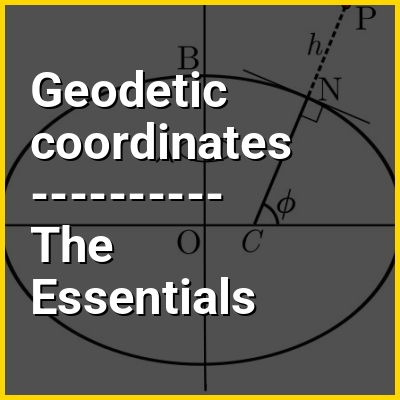
Geodetic coordinates are a type of curvilinear orthogonal coordinate system used in geodesy based on a reference ellipsoid.They include geodetic latitude (north/south) ϕ, longitude (east/west) λ, and ellipsoidal height h (also known as geodetic height). The triad is also known as Earth ellipsoidal coordinates (not to be confused with ellipsoidal-harmonic coordinates).
>>>PUT SHARE BUTTONS HERE<<<
In this Dossier
Geodetic coordinates in the context of Degree of latitude
A geographic coordinate system (GCS) is a spherical or geodetic coordinate system for measuring and communicating positions directly on Earth as latitude and longitude. It is the simplest, oldest, and most widely used type of the various spatial reference systems that are in use, and forms the basis for most others. Although latitude and longitude form a coordinate tuple like a cartesian coordinate system, geographic coordinate systems are not cartesian because the measurements are angles and are not on a planar surface.
A full GCS specification, such as those listed in the EPSG and ISO 19111 standards, also includes a choice of geodetic datum (including an Earth ellipsoid), as different datums will yield different latitude and longitude values for the same location.
Geodetic coordinates in the context of Geodetic datum
A geodetic datum or geodetic system (also: geodetic reference datum, geodetic reference system, or geodetic reference frame, or terrestrial reference frame) is a global datum reference or reference frame for unambiguously representing the position of locations on Earth by means of either geodetic coordinates (and related vertical coordinates) or geocentric coordinates. Datums are crucial to any technology or technique based on spatial location, including geodesy, navigation, surveying, geographic information systems, remote sensing, and cartography. A horizontal datum is used to measure a horizontal position, across the Earth's surface, in latitude and longitude or another related coordinate system. A vertical datum is used to measure the elevation or depth relative to a standard origin, such as mean sea level (MSL). A three-dimensional datum enables the expression of both horizontal and vertical position components in a unified form. The concept can be generalized for other celestial bodies as in planetary datums.
Since the rise of the global positioning system (GPS), the ellipsoid and datum WGS 84 it uses has supplanted most others in many applications. The WGS 84 is intended for global use, unlike most earlier datums.Before GPS, there was no precise way to measure the position of a location that was far from reference points used in the realization of local datums, such as from the Prime Meridian at the Greenwich Observatory for longitude, from the Equator for latitude, or from the nearest coast for sea level. Astronomical and chronological methods have limited precision and accuracy, especially over long distances. Even GPS requires a predefined framework on which to base its measurements, so WGS 84 essentially functions as a datum, even though it is different in some particulars from a traditional standard horizontal or vertical datum.