Generative model in the context of Statistical classification


Generative model in the context of Statistical classification

Generative model Study page number 1 of 1

Play TriviaQuestions Online!

or

Skip to study material about Generative model in the context of "Statistical classification"


⭐ Core Definition: Generative model

In statistical classification, two main approaches are called the generative approach and the discriminative approach. These compute classifiers by different approaches, differing in the degree of statistical modelling. Terminology is inconsistent, but three major types can be distinguished:

  1. A generative model is a statistical model of the joint probability distribution on a given observable variable X and target variable Y; A generative model can be used to "generate" random instances (outcomes) of an observation x.
  2. A discriminative model is a model of the conditional probability of the target Y, given an observation x. It can be used to "discriminate" the value of the target variable Y, given an observation x.
  3. Classifiers computed without using a probability model are also referred to loosely as "discriminative".

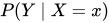
The distinction between these last two classes is not consistently made; Jebara (2004) refers to these three classes as generative learning, conditional learning, and discriminative learning, but Ng & Jordan (2002) only distinguish two classes, calling them generative classifiers (joint distribution) and discriminative classifiers (conditional distribution or no distribution), not distinguishing between the latter two classes. Analogously, a classifier based on a generative model is a generative classifier, while a classifier based on a discriminative model is a discriminative classifier, though this term also refers to classifiers that are not based on a model.

↓ Menu
HINT:

In this Dossier

Generative model in the context of Generative artificial intelligence

Generative artificial intelligence (Generative AI, or GenAI) is a subfield of artificial intelligence that uses generative models to produce text, images, videos, audio, software code or other forms of data. These models learn the underlying patterns and structures of their training data and use them to produce new data based on the input, which often comes in the form of natural language prompts.

Generative AI tools have become more common since the AI boom in the 2020s. This boom was made possible by improvements in transformer-based deep neural networks, particularly large language models (LLMs). Major tools include chatbots such as ChatGPT, Copilot, Gemini, Claude, Grok, and DeepSeek; text-to-image models such as Stable Diffusion, Midjourney, and DALL-E; and text-to-video models such as Veo and Sora. Technology companies developing generative AI include OpenAI, xAI, Anthropic, Meta AI, Microsoft, Google, Mistral AI, DeepSeek, Baidu and Yandex.

View the full Wikipedia page for Generative artificial intelligence
↑ Return to Menu

Generative model in the context of Deep belief network

In machine learning, a deep belief network (DBN) is a generative graphical model, or alternatively a class of deep neural network, composed of multiple layers of latent variables ("hidden units"), with connections between the layers but not between units within each layer.

When trained without supervision on a set of examples, a DBN can learn to probabilistically reconstruct its inputs. The layers then act as feature detectors. After this learning step, a DBN can be further trained with supervision to perform classification.

View the full Wikipedia page for Deep belief network
↑ Return to Menu

Generative model in the context of Generative adversarial network

A generative adversarial network (GAN) is a class of machine learning frameworks and a prominent framework for approaching generative artificial intelligence. The concept was initially developed by Ian Goodfellow and his colleagues in June 2014. In a GAN, two neural networks compete with each other in the form of a zero-sum game, where one agent's gain is another agent's loss.

Given a training set, this technique learns to generate new data with the same statistics as the training set. For example, a GAN trained on photographs can generate new photographs that look at least superficially authentic to human observers, having many realistic characteristics. Though originally proposed as a form of generative model for unsupervised learning, GANs have also proved useful for semi-supervised learning, fully supervised learning, and reinforcement learning.

View the full Wikipedia page for Generative adversarial network
↑ Return to Menu