The Proshyan dynasty, also Khaghbakians or Xaghbakian-Proshians (Armenian: Խաղբակյանք/Պռոշյանք), was a family of the Armenian nobility, named after its founder Prince Prosh Khaghbakian. The dynasty was a vassal of Zakarid Armenia during the 13th–14th century CE, established as nakharar feudal lords as a reward for their military successes. Zakarid Armenia was itself vassal of the Kingdom of Georgia from 1201, effectively falling under Mongol control after 1236, while Georgian rule only remained nominal. The Proshyans were princes of Bjni, Garni, Geghard and Noravank. The family prospered as an ally of the Mongols, following the Mongol invasions of Armenia and Georgia, as did the Zakarians and Orbelians. Despite heavy Mongol taxes, they benefited from trade routes to China under the control of the Mongols, and built many magnificent churches and monasteries.

>>>PUT SHARE BUTTONS HERE<<<
In this Dossier
Geghard in the context of Monolithic church
A monolithic church or rock-hewn church is a church made from a single block of stone. Because freestanding rocks of sufficient size are rare, such edifices are usually hewn into the ground or into the side of a hill or mountain. They can be of comparable architectural complexity to constructed buildings.
The term monolithic church is used of churches in various countries, not least the complex of eleven churches in Lalibela, Ethiopia, believed to have been created in the 12th century.
Geghard in the context of Cave monastery
A cave monastery is a monastery built in caves, with possible outside facilities. The 3rd-century monk St. Anthony the Great, known as the founder of Christian monasticism, lived in a cave.
- Albania
- Qafthanë Cave Church, cave church near Urakë
- St. Mary's Church, cave church in Maligrad, an island in the Prespa lake
- Armenia
- Geghard cave monastery/fortress
- Bosnia and Herzegovina
- Bulgaria
- Aladzha Monastery
- Albotin Monastery
- Basarbovo Monastery
- Rock-hewn Churches of Ivanovo
- Cave monasteries of Krepcha
- Monasteries of Provadia
- Cave monasteries on the Plateau of Shumen
- Cave monasteries of Tervel
- Egypt
- St. Simon the Tanner Monastery
- Ethiopia
- France
- Georgia
- David Gareja monastery complex
- Vanis Kvabebi cave monastery/fortress, Javakheti Plateau
- Vardzia cave city and monastery
- Greece
- various cave hermitages at Meteora
- various cave hermitages at Mount Athos
- caves at Karoulia
- Monastery of Saint Mark, Petroussa
- Hungary
- Gellért Hill Cave chapels and monastery, Budapest
- Iraq
- Rabban Hormizd Monastery, Alqosh
- Mar Qayuma Monastery, Dooreh
- Israel
- Qumran Caves, once inhabited by the Essenes
- Montenegro
- North Macedonia
- Romania
- Russia
- Serbia
- Blagoveštenje
- Crna Reka
- Gornjak
- Kađenica
- Churches of Kovilje Monastery
- Church of Sts. Peter and Paul, also known as the Cave Church, 14th-century church in Lukovo
- Church of Sts. Peter and Paul, in Rsovci, where was painted a unique fresco of bald Jesus
- Hermitage of St. Peter Koriški
- Savina
- Thailand
- Wat Tham Khan, Sakon Nakhon province
- Tiger Cave Temple (Wat Tam Sua), Krabi
- Turkey
- Cappadocia cave monasteries
- Cave monastery of İnceğiz
- Church of Saint Peter
- Ukraine
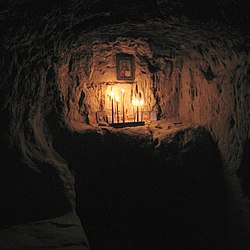
A cell in the caves of the Kytaiv Monastery - Bakhchysarai Cave Monastery in Crimea
- Chelter-Koba in Crimea
- Chylter-Marmara in Crimea
- Inkerman Cave Monastery in Crimea
- Assumption Cave Monastery in Zymne, Volyn Oblast
- Bakota Cave Monastery in Bakota, Khmelnytskyi Oblast
- Kachi-Kalon in Crimea
- Kyiv Pechersk Lavra (Near and Far Caves) in Kyiv
- Kytaiv Monastery in Kyiv
- Shuldan in Crimea
- Sviatohirsk Lavra in Sviatohirsk, Donetsk Oblast
- Yeletskyi Monastery (Saint Anthony's Caves) in Chernihiv
