Geats in the context of "Provinces of Sweden"

Play Trivia Questions online!

or

Skip to study material about Geats in the context of "Provinces of Sweden"

Ad spacer

⭐ Core Definition: Geats

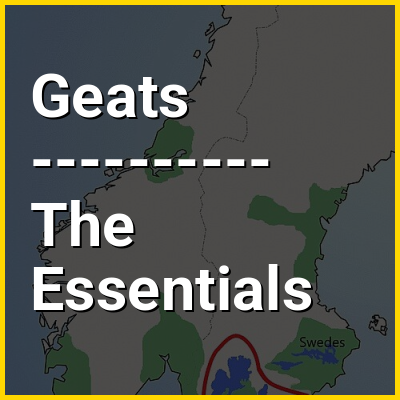
The Geats (/ɡts, ˈɡəts, jæts/ GHEETS, GAY-əts, YATS; Old English: gēatas [ˈjæɑtɑs]; Old Norse: gautar [ˈɡɑu̯tɑr]; Swedish: götar [ˈjø̂ːtar]), sometimes called Goths, were a large North Germanic tribe who inhabited Götaland ("land of the Geats") in modern southern Sweden from antiquity until the Late Middle Ages. They are one of the progenitor groups of modern Swedes, along with the tribes of Swedes and Gutes. The name of the Geats also lives on in the Swedish provinces of Västergötland and Östergötland, the western and eastern lands of the Geats, and in many other toponyms.

The Swedish dialects spoken in the areas that used to be inhabited by Geats form a distinct group, Götamål.

↓ Menu

>>>PUT SHARE BUTTONS HERE<<<
In this Dossier

Geats in the context of Beowulf

Beowulf (/ˈbəwʊlf/ ; Old English: Bēowulf [ˈbeːowuɫf]) is an Old English poem, an epic in the tradition of Germanic heroic legend consisting of 3,182 alliterative lines, contained in the Nowell Codex. It is one of the most important and most often translated works of Old English literature. The date of composition is a matter of contention among scholars; the only certain dating is for the manuscript, which was produced between AD 975 and 1025. Scholars call the anonymous author the "Beowulf poet". The story is set in pagan Scandinavia in the 5th and 6th centuries. Beowulf, a hero of the Geats, comes to the aid of Hrothgar, the king of the Danes, whose mead hall Heorot has been under attack by the monster Grendel for twelve years. After Beowulf slays him, Grendel's mother takes revenge and is in turn defeated. Victorious, Beowulf goes home to Geatland and becomes king of the Geats. Fifty years later, Beowulf defeats a dragon, but is mortally wounded in the battle. After his death, his attendants cremate his body and erect a barrow on a headland in his memory.

Scholars have debated whether Beowulf was transmitted orally, affecting its interpretation: if it was composed early, in pagan times, then the paganism is central and the Christian elements were added later, whereas if it was composed later, in writing, by a Christian, then the pagan elements could be decorative archaising; some scholars also hold an intermediate position. Beowulf is written mostly in the Late West Saxon dialect of Old English, but many other dialectal forms are present, suggesting that the poem may have had a long and complex transmission throughout the dialect areas of England.
↑ Return to Menu

Geats in the context of Sweden

Sweden, formally the Kingdom of Sweden, is a Nordic country located on the Scandinavian Peninsula in Northern Europe. It borders Norway to the west and north, and Finland to the east. At 450,295 square kilometres (173,860 sq mi), Sweden is the largest Nordic country by both area and population, and is the fifth-largest country in Europe. Its capital and largest city is Stockholm. Sweden has a population of 10.6 million, and a low population density of 25.5 inhabitants per square kilometre (66/sq mi); 88% of Swedes reside in urban areas. They are mostly in the central and southern half of the country. Sweden's urban areas together cover 1.5% of its land area. Sweden has a diverse climate owing to the length of the country, which ranges from 55°N to 69°N.

Sweden has been inhabited since prehistoric times around 12,000 BC. The inhabitants emerged as the Geats (Swedish: Götar) and Swedes (Svear), who formed part of the sea-faring peoples known as the Norsemen. A unified Swedish state was established during the late 10th century. In 1397, Sweden joined Norway and Denmark to form the Scandinavian Kalmar Union, which Sweden left in 1523. When Sweden became involved in the Thirty Years' War on the Protestant side, an expansion of its territories began, forming the Swedish Empire, which remained one of the great powers of Europe until the early 18th century. During this era Sweden controlled much of the Baltic Sea. Most of the conquered territories outside the Scandinavian Peninsula were lost during the 18th and 19th centuries. The eastern half of Sweden, present-day Finland, was lost to Imperial Russia in 1809. The last war in which Sweden was directly involved was in 1814, when Sweden by military means forced Norway into a personal union, a union which lasted until 1905.

↑ Return to Menu

Geats in the context of The Dragon (Beowulf)

The final act of the Anglo-Saxon poem Beowulf includes Beowulf's fight with a dragon, the third monster he encounters in the epic. On his return from Heorot, where he killed Grendel and Grendel's mother, Beowulf becomes king of the Geats and rules wisely for fifty years until a slave awakens and angers a dragon by stealing a jeweled cup from its lair. When the angry dragon mercilessly burns the Geats' homes (including Beowulf's) and lands, Beowulf decides to fight and kill the monster personally. He and his thanes climb to the dragon's lair where, upon seeing the beast, the thanes flee in terror, leaving only Wiglaf to battle at Beowulf's side. When the dragon wounds Beowulf fatally, Wiglaf attacks it with his sword, and Beowulf kills it with his dagger.

This depiction indicates the growing importance and stabilization of the modern concept of the dragon within European mythology. Beowulf is the first piece of English literature to present a dragonslayer. Although the Beowulf dragon exhibits many existing motifs common to Germanic tradition, the Beowulf poet was the first to combine features and present a distinctive fire-breathing dragon. The Beowulf dragon was adapted for Middle-earth in J. R. R. Tolkien's The Hobbit (1937), one of the forerunners of modern high fantasy.

↑ Return to Menu

Geats in the context of Birger Jarl

Birger Jarl or Birger Magnusson (c. 1210 – 21 October 1266) was a Swedish statesman and regent, jarl, and a member of the House of Bjälbo, who played a pivotal role in consolidating Sweden after the civil wars between the House of Erik and the House of Sverker. His first marriage was to Princess Ingeborg of Sweden, which created his base of power. Birger led the Second Swedish Crusade, which established Swedish rule in Finland. Additionally, he is traditionally attributed with the foundation of the Swedish capital, Stockholm, around 1250. Birger used the Latin title of dux sveorum et guttorum ("duke of Swedes and Geats").

↑ Return to Menu

Geats in the context of Swedes (tribe)

The Swedes (Swedish: svear; Old Norse: svíar, Old English: Swēon) were a North Germanic tribe who inhabited Svealand ("land of the Swedes") in central Sweden. Along with Geats and Gutes, they were one of the progenitor groups of modern Swedes.

The Roman historian Tacitus was the first to write about the tribe in his Germania from AD 98, referring to them as the Suiones. Locally, they are possibly first mentioned by the Kylver Stone in the 4th century. Jordanes, in the 6th century, mentions Suehans and Suetidi. These names likely derive from the Proto-Indo-European root *s(w)e, meaning "one's own". Beowulf mentions the Swedes around 1000 A.D.

↑ Return to Menu

Geats in the context of Jutes

The Jutes (/ts/ JOOTS) were one of the Germanic tribes who settled in Great Britain after the departure of the Romans. According to Bede, they were one of the three most powerful Germanic nations, along with the Angles and the Saxons:

There is no consensus amongst historians on the origins of the Jutes. One hypothesis is that they originated from the Jutland Peninsula but after a Danish invasion of that area, migrated to the Frisian coast. From the Frisian coast they went on to settle southern Britain in the later fifth century during the Migration Period, as part of a larger wave of Germanic migration into Britain.They were possibly or probably related to the North Germanic tribe Geats.

↑ Return to Menu

Geats in the context of Gutes

The Gutes (Old West Norse: Gotar, Old Gutnish: Gutar) were a North Germanic tribe inhabiting the island of Gotland. The ethnonym is related to that of the Goths (Gutans), and both names were originally Proto-Germanic *Gutaniz. Their language is called Gutnish (gutniska). They are one of the progenitor groups of modern Swedes, along with historical Swedes and Geats.

↑ Return to Menu

Geats in the context of North Germanic peoples

North Germanic peoples, Nordic peoples and in a medieval context Norsemen, were a Germanic linguistic group originating from the Scandinavian Peninsula. They are identified by their cultural similarities, common ancestry and common use of the Proto-Norse language from around 200 AD, a language that around 800 AD became the Old Norse language, which in turn later became the North Germanic languages of today.

The North Germanic peoples are thought to have emerged as a distinct people in what is now southern Sweden in the early centuries AD. Several North Germanic tribes are mentioned by classical writers in antiquity, in particular the Swedes, Danes, Geats, Gutes and Rugii. During the subsequent Viking Age, seafaring North Germanic adventurers, commonly referred to as Vikings, raided and settled territories throughout Europe and beyond, founding several important political entities and exploring the North Atlantic as far as North America. Groups that arose from this expansion include the Normans, the Norse–Gaels and the Rus' people. The North Germanic peoples of the Viking Age went by various names among the cultures they encountered, but are generally referred to as Norsemen.

↑ Return to Menu