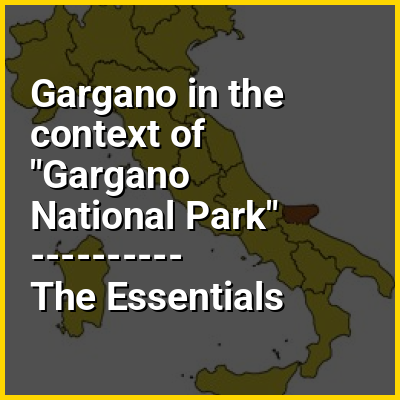
Gargano (Italian: [ɡarˈɡaːno]) is a historical and geographical sub-region in the province of Foggia, Apulia, southeast Italy, consisting of a wide isolated mountain massif made of highland and several peaks and forming the backbone of a promontory projecting into the Adriatic Sea, the "spur" on the Italian "boot".
HINT:
In this Dossier
- ⭐ Core Definition: Gargano
- Gargano in the context of Daunians
- Gargano in the context of Monte Conero
- Gargano in the context of Duke of Apulia and Calabria
- Gargano in the context of Abruzzo Airport
- Gargano in the context of Canusium
Gargano in the context of Daunians
The Daunians (Latin: Daunii) were an Iapygian tribe that inhabited northern Apulia in classical antiquity. Two other Iapygian tribes, the Peucetians and the Messapians, inhabited the central and southern Apulia respectively. Although all three tribes spoke the Messapic language, they had developed separate archaeological cultures by the seventh century BC.
The Daunians lived in the Daunia region, which extended from the Daunian Mountains river in the southeast to the Gargano peninsula in the northwest. This region is mostly coincident with the Province of Foggia and part of Province of Barletta-Andria-Trani today. Daunians and Oscans came into contact in northern Daunia and southern Samnite regions. Gradually, parts of northern Daunia became "Oscanized".
View the full Wikipedia page for DauniansGargano in the context of Monte Conero
Monte Conero (Italian pronunciation: [ˈmonte ˈkɔːnero]) or Mount Conero, also known as Monte d'Ancona (Mount of Ancona), is a promontory in Italy, situated directly south of the port of Ancona on the Adriatic Sea.
Mount Conero is 572 m (1,877 feet) high and it is the only coastal high point on the Adriatic sea between Trieste and the Gargano massif in the region of Apulia.
View the full Wikipedia page for Monte ConeroGargano in the context of Duke of Apulia and Calabria
The County of Apulia and Calabria (Latin: Comitatus Apuliae et Calabriae), later the Duchy of Apulia and Calabria (Latin: Ducatus Apuliae et Calabriae), was a Norman state founded by William of Hauteville in 1043, composed of the territories of Gargano, Capitanata, Apulia, Vulture, and most of Campania. It became a duchy when Robert Guiscard was raised to the rank of duke by Pope Nicholas II in 1059.
The duchy was disestablished in 1130, when the last duke of Apulia and Calabria, Roger II, became King of Sicily. The title of duke was thereafter used intermittently as a title for the heir apparent to the Kingdom of Sicily.
View the full Wikipedia page for Duke of Apulia and CalabriaGargano in the context of Abruzzo Airport
Abruzzo Airport (IATA: PSR, ICAO: LIBP) is an international airport serving Pescara, Italy. It is located approximately 4 kilometres (2.5 mi) from the centre of Pescara, about 180 km (110 mi) from Rome, a 2-hour drive by car on a motorway across the Apennine Mountains. The airport is located on the state road 5 Via Tiburtina Valeria and is connected to important roads (Autostrada A25, Autostrada A14, SS714 Tangenziale di Pescara) and railway connections (Rome–Sulmona–Pescara railway, Adriatic railway).
Being the only international airport in the Abruzzo region, it plays a fundamental role for the transportation and aerial connection of the area and for that of neighbouring regions; catering also for people from Molise, Marche and the Gargano area. The airport has seen a steady increase in the number of transit passengers over the years, mainly due to a growth in low-cost airlines and flights. The terminal built in 1996 has been extended in 2011 and recently restructured in 2018.
View the full Wikipedia page for Abruzzo AirportGargano in the context of Canusium
Canosa di Puglia, generally known simply as Canosa (Canosino: Canaus), is a town and comune in the province of Barletta-Andria-Trani, Apulia, southern Italy. It is located between Bari and Foggia, on the northwestern edge of the plateau of the Murgia which dominates the Ofanto valley and the extensive plains of Tavoliere delle Puglie, ranging from Mount Vulture at the Gargano, to the Adriatic coast. Canosa, the Roman Canusium, is considered the principal archaeological center of Apulia, and is one of the oldest continually inhabited cities in Italy. A number of vases and other archaeological finds are located in local museums and private collections. It is not far from the position on the Ofanto River where the Romans found refuge after the defeat of the Battle of Cannae and is the burial place of Bohemund I of Antioch.
View the full Wikipedia page for Canusium