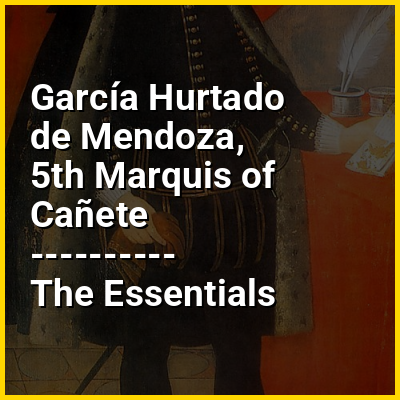
García Hurtado de Mendoza y Manrique, 5th Marquis of Cañete (July 21, 1535 – May 19, 1609) was a Spanish Governor of Chile, and later Viceroy of Peru (from January 8, 1590 to July 24, 1596). He is often known simply as "Marquis of Cañete". Belonging to an influential family of Spanish noblemen Hurtado de Mendoza successfully fought in the Arauco War during his stay as Governor of Chile. The city of Mendoza is named after him. In his later position as Viceroy of Peru he sponsored Álvaro de Mendaña's transpacific expedition of 1595, who named the Marquesas Islands after him.
HINT:
In this Dossier
- ⭐ Core Definition: García Hurtado de Mendoza, 5th Marquis of Cañete
- García Hurtado de Mendoza, 5th Marquis of Cañete in the context of Marquesas Islands
- García Hurtado de Mendoza, 5th Marquis of Cañete in the context of Lemucaguin
García Hurtado de Mendoza, 5th Marquis of Cañete in the context of Marquesas Islands
The Marquesas Islands (/mɑːrˈkeɪsəs/ mar-KAY-səss; French: Îles Marquises or Archipel des Marquises or Marquises [maʁkiz]; Marquesan: Te Henua ʻEnana (North Marquesan) and Te Fenua ʻEnata (South Marquesan), both meaning "the land of men") are a group of volcanic islands in French Polynesia, an overseas collectivity of France in the southern Pacific Ocean. Their highest point is the peak of Mount Oave (French: Mont Oave) on Ua Pou island, at 1,230 m (4,035 ft) above sea level.
Archaeological research suggests the islands were settled in the 10th century AD by voyagers from West Polynesia. Over the centuries that followed, the islands have maintained a "remarkably uniform culture, biology and language". The Marquesas were named after the 16th-century Spanish Viceroy of Peru, the Marquis of Cañete (Spanish: Marqués de Cañete), by navigator Álvaro de Mendaña, who visited them in 1595.
View the full Wikipedia page for Marquesas IslandsGarcía Hurtado de Mendoza, 5th Marquis of Cañete in the context of Lemucaguin
Lemucaguin a native of Andalicán was the successor to Turcupichun as toqui of the Moluche Butalmapu north of the Biobío River in 1558. He organized a detachment of arquebusiers from weapons captured in the Battle of Marihueñu. He continued the war against García Hurtado de Mendoza after the executions of Caupolican and Turcupichun. Establishing pucaras at Quiapo and other locations to block Spanish access to the Arauco region. He was the first toqui to use firearms and artillery in the Battle of Quiapo However he was killed in this battle and was replaced by Illangulién. The later historian, Juan Ignacio Molina, calls the toqui that led at Quiapo Caupolicán the younger, son the executed toqui Caupolican
View the full Wikipedia page for Lemucaguin