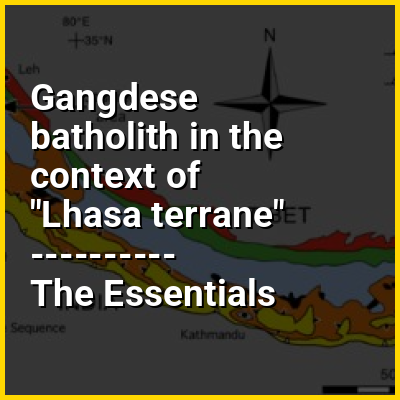
The Gangdese batholith or Gangdese volcanic arc is a major geological structure in the south of the Lhasa terrane in Tibet, to the north of the Himalayas. The batholith formed around 100 million years ago, and was volcanically active for about 20 million years. It reactivated around 65 million years ago as the Indian plate approached Eurasia, and was active for another 20 million years.
HINT:
In this Dossier
Gangdese batholith in the context of Magmatism
Magmatism is the emplacement of magma within and at the surface of the outer layers of a terrestrial planet, which solidifies as igneous rocks. It does so through magmatic activity or igneous activity, the production, intrusion and extrusion of magma or lava. Volcanism is the surface expression of magmatism.
Magmatism is one of the main processes responsible for mountain formation. The nature of magmatism depends on the tectonic setting. For example, andesitic magmatism is associated with the formation of island arcs at convergent plate boundaries while basaltic magmatism is found at mid-ocean ridges during sea-floor spreading at divergent plate boundaries.
View the full Wikipedia page for Magmatism