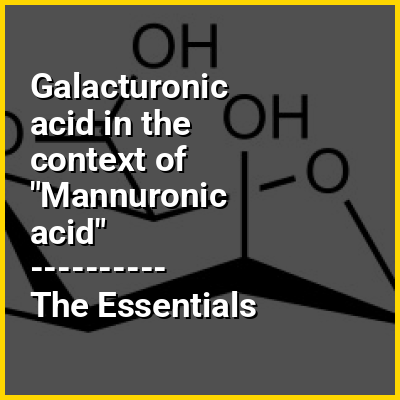
d-Galacturonic acid is a sugar acid, an oxidized form of d-galactose. It is the main component of pectin, in which it exists as the polymer polygalacturonic acid. In its open form, it has an aldehyde group at C1 and a carboxylic acid group at C6. Other oxidized forms of d-galactose are d-galactonic acid (carboxylic group at C1) and meso-galactaric acid (mucic acid) (carboxylic groups at C1 and C6). It is also a uronic acid or hexuronic acid. Naturally occurring uronic acids are d-glucuronic acid, d-galacturonic acid, l-iduronic acid and d-mannuronic acid.
HINT:
In this Dossier
- ⭐ Core Definition: Galacturonic acid
- Galacturonic acid in the context of Pectin
- Galacturonic acid in the context of Polygalacturonase
Galacturonic acid in the context of Pectin
Pectin (Ancient Greek: πηκτικός pēktikós: 'congealed' and 'curdled') is a heteropolysaccharide, a structural polymer contained in the cell walls and middle lamellae of terrestrial plants. The principal chemical component of pectin is galacturonic acid (a sugar acid derived from galactose) which was isolated and described by Henri Braconnot in 1825. Commercially produced pectin is a white-to-light-brown powder, produced from citrus fruits for use as an edible gelling agent, especially in jams and jellies, dessert fillings, medications, and sweets; as a food stabiliser in fruit juices and milk drinks; and as a source of dietary fiber.
View the full Wikipedia page for PectinGalacturonic acid in the context of Polygalacturonase
Endo-polygalacturonase (EC 3.2.1.15, pectin depolymerase, pectolase, pectin hydrolase, and poly-α-1,4-galacturonide glycanohydrolase; systematic name (1→4)-α-D-galacturonan glycanohydrolase (endo-cleaving)) is an enzyme that hydrolyzes the α-1,4 glycosidic bonds between galacturonic acid residues:
Polygalacturonan, whose major component is galacturonic acid, is a significant carbohydrate component of the pectin network that comprises plant cell walls. Therefore, the activity of the endogenous plant PGs works to soften and sweeten fruit during the ripening process. Similarly, phytopathogens use PGs as a means to weaken the pectin network, so that digestive enzymes can be excreted into the plant host to acquire nutrients.
View the full Wikipedia page for Polygalacturonase