Gabriele D'Annunzio in the context of "Military Order of Savoy"

Play Trivia Questions online!

or

Skip to study material about Gabriele D'Annunzio in the context of "Military Order of Savoy"


⭐ Core Definition: Gabriele D'Annunzio

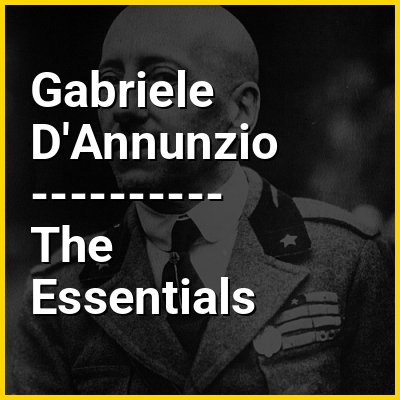
General Gabriele D'Annunzio, Prince of Montenevoso OMS CMG MVM (UK: /dæˈnʊntsi/, US: /dɑːˈnn-/; Italian: [ɡabriˈɛːle danˈnuntsjo]; 12 March 1863 – 1 March 1938), sometimes written d'Annunzio as he used to sign himself, was an Italian poet, playwright, orator, journalist, aristocrat, and Royal Italian Army officer during World War I. He occupied a prominent place in Italian literature from 1889 to 1910 and in its political life from 1914 to 1924. He had the epithets il Profeta (The Prophet) and il Vate (The Poet): vate stems from the Latin vates, meaning a prophetic, divinatory, or inspirational poet.

D'Annunzio was associated with the Decadent movement in his literary works, which interplayed closely with French symbolism and British aestheticism. Such works represented a turn against the naturalism of the preceding romantics and was both sensuous and mystical. He came under the influence of Friedrich Nietzsche, which would find outlets in his literary and later political contributions. His affairs with several women, including Eleonora Duse and Luisa Casati, received public attention. In his politics, which evolved many times, he associated himself with socialism and the progressivist views of the political left, responding to the illiberal and reactionary policies of Luigi Pelloux, as well as with the Historical Far Left.
↓ Menu

In this Dossier

Gabriele D'Annunzio in the context of Fascism in Europe

Fascist movements in Europe were the set of various fascist ideologies which were practiced by governments and political organizations in Europe during the 20th century. Fascism was born in Italy following World War I, and other fascist movements, influenced by Italian fascism, subsequently emerged across Europe. Among the political doctrines which are identified as ideological origins of fascism in Europe are the combining of a traditional national unity and revolutionary anti-democratic rhetoric which was espoused by the integral nationalist Charles Maurras and the revolutionary syndicalist Georges Sorel.

The earliest foundations of fascism in practice can be seen in the Italian Regency of Carnaro, led by the Italian nationalist Gabriele D'Annunzio, many of whose politics and aesthetics were subsequently used by Benito Mussolini and his Italian Fasces of Combat which Mussolini had founded as the Fasces of Revolutionary Action in 1914. Despite the fact that its members referred to themselves as "fascists", the ideology was based around national syndicalism. The ideology of fascism would not fully develop until 1921, when Mussolini transformed his movement into the National Fascist Party, which then in 1923 incorporated the Italian Nationalist Association. The INA established fascist tropes such as colored shirt uniforms and also received the support of important proto-fascists like D'Annunzio and nationalist intellectual Enrico Corradini.

↑ Return to Menu

Gabriele D'Annunzio in the context of Mutilated victory

Mutilated victory (Italian: vittoria mutilata) is a term coined by Gabriele D'Annunzio at the end of World War I, used by a part of Italian nationalists to denounce the partial infringement (and request the full application) of the 1915 Treaty of London concerning territorial rewards for Kingdom of Italy.

In the 1915 treaty, Italy had agreed to join the powers of the Triple Entente in their war against Austria-Hungary and the German Empire in exchange for the Entente powers’ recognition of Italy’s control over Southern Tyrol, the Austrian Littoral and territories in Dalmatia. These lands were inhabited by Italians—alongside Austrian Germans (Tyroleans) and Slavs (Slovenes and Croats)—but had not become part of the Kingdom upon Italian unification in the late 19th century. Additionally, Italy was assured ownership of the Dodecanese, possessions in Albania, and a sphere of influence around the Turkish city of Antalya, alongside a possible enlargement of its colonial presence in Africa.

↑ Return to Menu

Gabriele D'Annunzio in the context of Eleonora Duse

Eleonora Giulia Amalia Duse (/ˈdjz/ DEW-zay, Italian: [eleoˈnɔːra ˈduːze]; 3 October 1858 – 21 April 1924), often known simply as Duse, was an Italian actress, rated by many as the greatest of her time. She performed in many countries, notably in the plays of Gabriele D'Annunzio and Henrik Ibsen. Duse achieved a unique power of conviction and verity on the stage through intense absorption in the character, "eliminating the self" as she put it, and letting the qualities emerge from within, not imposed through artifice.

↑ Return to Menu

Gabriele D'Annunzio in the context of La Rinascente

La Rinascente (Italian for '"she who is reborn"'; pronounced [la rinaʃˈʃɛnte]) is a high-end Italian department store chain. Founded in Milan in 1865, it adopted its current name in 1917, coined by the poet Gabriele D'Annunzio. In 1954, the company launched the Compasso d'Oro, an Italian industrial design award later managed by the ADI. In 2016, its Milan store at Piazza del Duomo was named "Best Department Store in the World" by the Intercontinental Group of Department Stores (IGDS).

The chain operates nine stores in Italy, including two flagship locations in Milan (Piazza del Duomo) and Rome (Via del Tritone).

↑ Return to Menu

Gabriele D'Annunzio in the context of Romaine Brooks

Romaine Brooks (born Beatrice Romaine Goddard; May 1, 1874 – December 7, 1970) was an American painter who worked mostly in Paris and Capri. She specialized in portraiture and used a subdued tonal palette keyed to the color gray. Brooks ignored contemporary artistic trends such as Cubism and Fauvism, drawing on her own original aesthetic inspired by the works of Charles Conder, Walter Sickert, and James McNeill Whistler. Her subjects ranged from anonymous models to titled aristocrats. She is best known for her images of women in androgynous or masculine dress, including her self-portrait of 1923, which is her most widely reproduced work.

Although her family was wealthy, Brooks had an unhappy childhood after her alcoholic father abandoned the family; her mother was emotionally abusive and her brother mentally ill. By her own account, her childhood cast a shadow over her whole life. She spent several years in Italy and France as a poor art student, then inherited a fortune upon her mother's death in 1902. Wealth gave her the freedom to choose her own subjects. She often painted people close to her, such as the Italian writer and politician Gabriele D'Annunzio, the Russian dancer Ida Rubinstein, and her partner of more than 50 years, the writer Natalie Barney.

↑ Return to Menu