Gällivare dialects in the context of Lannankieli


Gällivare dialects in the context of Lannankieli

⭐ Core Definition: Gällivare dialects

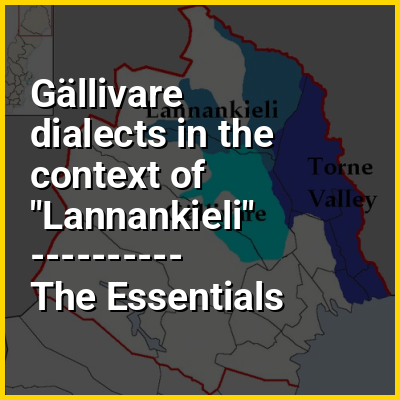
Gällivare dialects (Meänkieli: Jellivaaranvarieteetti), alternately Gällivare Finnish (Swedish: Gällivarefinska, Finnish: Jällivaaransuomi), the Gällivare variant (Swedish: Gällivarevarietet) or, in more colloquial Swedish, village Finnish (byfinska), are a dialect group of Meänkieli (which also includes the Torne Valley dialects and Lannankieli). Meänkieli is recognized in Sweden as an independent Finnic language for political, sociological and historical reasons, but it is sometimes considered as a group of Peräpohjola dialects of Finnish due to their close mutual intelligibility. The Gällivare dialects are spoken around Gällivare, but also in Killivaara and Nattavaara.

Features of the dialects are absence of Vowel harmony: kyla 'village' (Meänkieli and Finnish: kylä), and the passive being used for the third person plural ending: äijät poltethin (Finnish: ukot polttivat). The dialect is also heavily influenced by Swedish and many loanwords have entered the Gällivare dialects. A Gällivare dialect dictionary was made in 1992 by Birger Winsa.
↓ Menu
HINT:

In this Dossier

Gällivare dialects in the context of Meänkieli language

Meänkieli (literally 'our language'), or Tornedalian is a Finnic language or a group of distinct Finnish dialects spoken in the northernmost part of Sweden, particularly along the Torne River Valley. It is officially recognized in Sweden as one of the country's five minority languages and is treated as a separate language from Finnish. According to the National Association of Swedish Tornedalians, 70,000 individuals understand Meänkieli, at least to some level.

Meänkieli is particularly similar to the Kven language and the Peräpohjola dialects of Finnish spoken in Finland, and it is strongly mutually intelligible with them. Its status as an independent language is sometimes disputed due to this high degree of mutual intelligibility. However, Meänkieli contains strong influences from Swedish, a number of loanwords from the Saamic languages, preserved some archaic features that even the Northern Finnish dialects have lost, and lacks the changes which standard Finnish experienced in the 19th to 20th centuries. As a result, while Meänkieli is often intelligible to speakers of Finnish, Standard Finnish is often very difficult for speakers of Meänkieli to understand. The Gällivare varieties of Meänkieli differ even more significantly from Standard Finnish and from other Finnish dialects, notably particularly their complete absence of vowel harmony.

View the full Wikipedia page for Meänkieli language
↑ Return to Menu

Gällivare dialects in the context of Peräpohjola dialects

The Peräpohjola dialects (Finnish: Peräpohjalaiset murteet) are a group of Finnish dialects traditionally spoken in the regions of Lapland, Norrbotten and Finnmark. However, due to primarily historical, political and sociological reasons, some traditional Peräpohja dialects have been granted the status of independent Finnic languages in Sweden and Norway. These forms of speech are called Meänkieli in Sweden (Including the Torne Valley dialects, Lannankieli and the Gällivare dialects), while in Norway the traditional Ruija dialects were recognized as forming the Kven language, which both were isolated from the development of modern standard Finnish. However, the status of these two Finnic variants as their own languages is still sometimes disputed due to their close mutual intelligibility with Finnish.

View the full Wikipedia page for Peräpohjola dialects
↑ Return to Menu