Fundamental Constitutions of Carolina in the context of "Province of Carolina"

Play Trivia Questions online!

or

Skip to study material about Fundamental Constitutions of Carolina in the context of "Province of Carolina"

Ad spacer

⭐ Core Definition: Fundamental Constitutions of Carolina

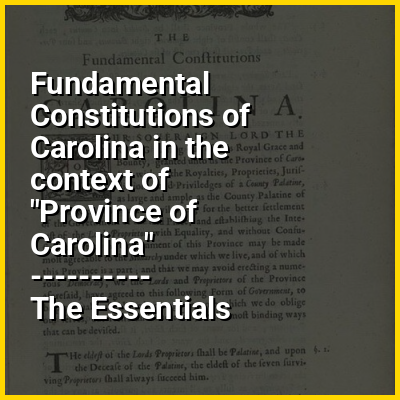
The Fundamental Constitutions of Carolina were adopted on March 1, 1669 by the eight Lords Proprietors of the Province of Carolina, which included most of the land between what is now Virginia and Florida. It replaced the Charter of Carolina and the Concessions and Agreements of the Lords Proprietors of the Province of Carolina (1665). The date March 1, 1669, was the date that proprietors confirmed the Constitutions and sent them to the Colony, but later on two other versions were introduced in 1682 and in 1698. Moreover, the proprietors suspended the Constitutions in 1690. Despite the claims of proprietors on the valid version of the Constitution, the colonists officially recognized the July 21, 1669, version, claiming that six proprietors had sealed the Constitutions as "the unalterable form and rule of Government forever" on that date. The earliest draft of this version in manuscript is believed to be the one found at Columbia, South Carolina archives.

The Constitutions were "reactionary" and "experimented with a non-common law system designed to encourage a feudal social structure", including through the use of non-unanimous jury decisions for criminal convictions. Some scholars think that the Colonists, settlers, and the British Crown kept themselves at a distance to the Constitutions from the beginning; however, others argue that it was a legal document that drew on the King's earlier charter to the colony and reflected crucial legal realities. While the provisions of the Fundamental Constitutions were never fully employed nor ratified, the Constitutions did help to shape power in the Carolinas and especially land distribution. Colonists' main concerns over the document were its exaltation of proprietors as noblemen at the apex of the hierarchically designed society. Second, the Constitutions had rules that were hard to implement by settlers for practical reasons. Thus, the proprietors had to amend the rules five times. They were repealed in part after the revolution against James II—the Glorious Revolution—which also reflected a partial reaction against such principles; however, for eight proprietors and the king who were the authors of the "Fundamental Constitutions", it reflected the proper order of governance, or as they wrote, they were creating a government with lords so "that the government of this province may be made most agreeable to the monarchy under which we live and of which this province is a part; and that we may avoid erecting a numerous democracy."
↓ Menu

>>>PUT SHARE BUTTONS HERE<<<
In this Dossier

Fundamental Constitutions of Carolina in the context of Two Treatises of Government

Two Treatises of Government (full title: Two Treatises of Government: In the Former, The False Principles, and Foundation of Sir Robert Filmer, and His Followers, Are Detected and Overthrown. The Latter Is an Essay Concerning The True Original, Extent, and End of Civil Government) is a work of political philosophy published anonymously in 1689 by John Locke. The First Treatise attacks patriarchalism in the form of sentence-by-sentence refutation of Robert Filmer's Patriarcha, while the Second Treatise outlines Locke's ideas for a more civilized society based on natural rights and contract theory. The book is a key foundational text in the theory of liberalism.

This publication contrasts with former political works by Locke himself. In Two Tracts on Government, written in 1660, Locke defends a very conservative position; however, Locke never published it. In 1669, Locke co-authored the Fundamental Constitutions of Carolina, which endorses aristocracy, slavery and serfdom. Some dispute the extent to which the Fundamental Constitutions of Carolina portray Locke's own philosophy as opposed to that of the Lord proprietors of the colony—it was a legal document written for and signed and sealed by the eight Lord proprietors to whom Charles II of England had granted the colony. In this context, Locke was a paid secretary.

↑ Return to Menu

Fundamental Constitutions of Carolina in the context of Anthony Ashley Cooper, 1st Earl of Shaftesbury

Anthony Ashley Cooper, 1st Earl of Shaftesbury PC, FRS (22 July 1621 – 21 January 1683), was an English statesman and peer. He held senior political office under both the Commonwealth of England and Charles II, serving as Chancellor of the Exchequer from 1661 to 1672 and Lord Chancellor from 1672 to 1673. During the Exclusion Crisis, Shaftesbury headed the movement to bar the Catholic heir, James II, from the royal succession, which is often seen as the origin of the Whig party. He was also a patron of the political philosopher John Locke, with whom Shaftesbury collaborated in writing the Fundamental Constitutions of Carolina in 1669.

During the Wars of the Three Kingdoms, Shaftesbury initially supported the Royalists, before switching to the Parliamentarians in 1644. He served on the English Council of State under the Commonwealth, although he opposed Oliver Cromwell's attempt to rule without Parliament during the Rule of the Major-Generals (1655–1657). He backed the Stuart Restoration in May 1660, and was raised to the peerage of England as Lord Ashley by Charles II.

↑ Return to Menu