Friedrich Hölderlin in the context of "Novalis"

Play Trivia Questions online!

or

Skip to study material about Friedrich Hölderlin in the context of "Novalis"

Ad spacer

⭐ Core Definition: Friedrich Hölderlin

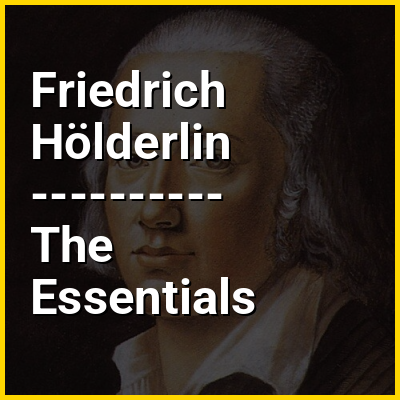
Johann Christian Friedrich Hölderlin (UK: /ˈhɜːldərln/, US: /ˈhʌl-/; German: [ˈfʁiːdʁɪç ˈhœldɐliːn] ; 20 March 1770 – 7 June 1843) was a German poet and philosopher. Described by Norbert von Hellingrath as "the most German of Germans", Hölderlin was a key figure of German Romanticism. Particularly due to his early association with and philosophical influence on Georg Wilhelm Friedrich Hegel and Friedrich Wilhelm Joseph Schelling, he was also an important thinker in the development of German Idealism.

Born in Lauffen am Neckar, Hölderlin had a childhood marked by bereavement. His mother intended for him to enter the Lutheran ministry, and he attended the Tübinger Stift, where he was friends with Hegel and Schelling. He graduated in 1793 but could not devote himself to the Christian faith, instead becoming a tutor. Two years later, he briefly attended the University of Jena, where he interacted with Johann Gottlieb Fichte and Novalis, before resuming his career as a tutor. He struggled to establish himself as a poet, and was plagued by mental illness. He was sent to a clinic in 1806 but deemed incurable and instead given lodging by a carpenter, Ernst Zimmer. He spent the final 36 years of his life in Zimmer's residence, and died in 1843 at the age of 73.
↓ Menu

>>>PUT SHARE BUTTONS HERE<<<
In this Dossier

Friedrich Hölderlin in the context of Apollonian and Dionysian

The Apollonian and the Dionysian are philosophical and literary concepts represented by a duality between the figures of Apollo and Dionysus from Greek mythology. Its popularization is widely attributed to the work The Birth of Tragedy by Friedrich Nietzsche, though the terms had already been in use prior to this, such as in the writings of poet Friedrich Hölderlin, historian Johann Joachim Winckelmann, and others. The word Dionysian occurs as early as 1608 in Edward Topsell's zoological treatise The History of Serpents. The concept has since been widely invoked and discussed within Western philosophy and literature.

In Greek mythology, Apollo and Dionysus are both sons of Zeus. Apollo, son of Leto, is the god of the sun, art, plague and disease, of rational thinking and order, and appeals to logic, prudence and purity and stands for reason. Dionysus, son of Semele, is the god of wine, dance and pleasure, of irrationality and chaos, representing passion, emotions and instincts. The ancient Greeks did not consider the two gods to be opposites or rivals, although they were often entwined by nature.

↑ Return to Menu

Friedrich Hölderlin in the context of Johann Joachim Winckelmann

Johann Joachim Winckelmann (US: /ˈvɪŋkəlmɑːn/ VINK-əl-mahn; German: [ˈjoːhan ˈjoːaxɪm ˈvɪŋkl̩man]; 9 December 1717 – 8 June 1768) was a German art historian and archaeologist. He was a pioneering Hellenist who first articulated the differences between Greek, Greco-Roman and Roman art. "The prophet and founding hero of modern archaeology", Winckelmann was one of the founders of scientific archaeology and first applied the categories of style on a large, systematic basis to the history of art. Many consider him the father of the discipline of art history. He was one of the first to separate Greek Art into periods, and time classifications.

He had a decisive influence on the rise of the Neoclassical movement during the late 18th century. His writings influenced not only a new science of archaeology and art history but Western painting, sculpture, literature and even philosophy. Winckelmann's History of Ancient Art (1764) was one of the first books written in German to become a classic of European literature. His subsequent influence on Gotthold Ephraim Lessing, Johann Gottfried Herder, Johann Wolfgang von Goethe, Friedrich Hölderlin, Heinrich Heine, Friedrich Nietzsche, Stefan George and Oswald Spengler has been provocatively called "the Tyranny of Greece over Germany".

↑ Return to Menu

Friedrich Hölderlin in the context of Norbert von Hellingrath

Friedrich Norbert Theodor von Hellingrath (21 March 1888 – 14 December 1916) was a German literary scholar whose main contribution to literary scholarship is the first complete edition of the works of the poet Friedrich Hölderlin.

↑ Return to Menu

Friedrich Hölderlin in the context of Lauffen am Neckar

Lauffen am Neckar (German pronunciation: [ˌlaʊfn̩ ʔam ˈnɛkaʁ] , lit.'Lauffen on the Neckar') or simply Lauffen is a town in the district of Heilbronn, Baden-Württemberg, Germany. It is on the river Neckar, 9 kilometres (6 miles) southwest of Heilbronn. The town is famous as the birthplace of the poet Friedrich Hölderlin and for its quality wines – in particular the "Lauffener Katzenbeißer Schwarzriesling".

↑ Return to Menu

Friedrich Hölderlin in the context of Tübinger Stift

The Tübinger Stift (German: [ˈtyːbɪŋɐ ˈʃtɪft] ) is a hall of residence and teaching; it is owned and supported by the Evangelical-Lutheran Church in Württemberg, and located in the university city of Tübingen, in South West Germany. The Stift was founded as an Augustinian monastery in the Middle Ages. After the Reformation, in 1536, Duke Ulrich turned the Stift into a seminary which served to prepare Protestant pastors for Württemberg. To this day the scholarship is still given to students in preparation for the ministry or teaching in Baden-Württemberg. Students receive a scholarship which consists of boarding, lodging and further academic support.

Some of the well known "Stiftlers" are the astronomer Johannes Kepler and his associate, statesman Hans Ulrich von Eggenberg, the poet Friedrich Hölderlin who had as roommates the philosophers G. W. F. Hegel and Friedrich Schelling (although the latter was five years their junior), the theologians David Friedrich Strauß, Johann Albrecht Bengel, Friedrich Christoph Oetinger, Ferdinand Christian Baur and Eberhard Nestle, and the philologist August Pauly.

↑ Return to Menu